
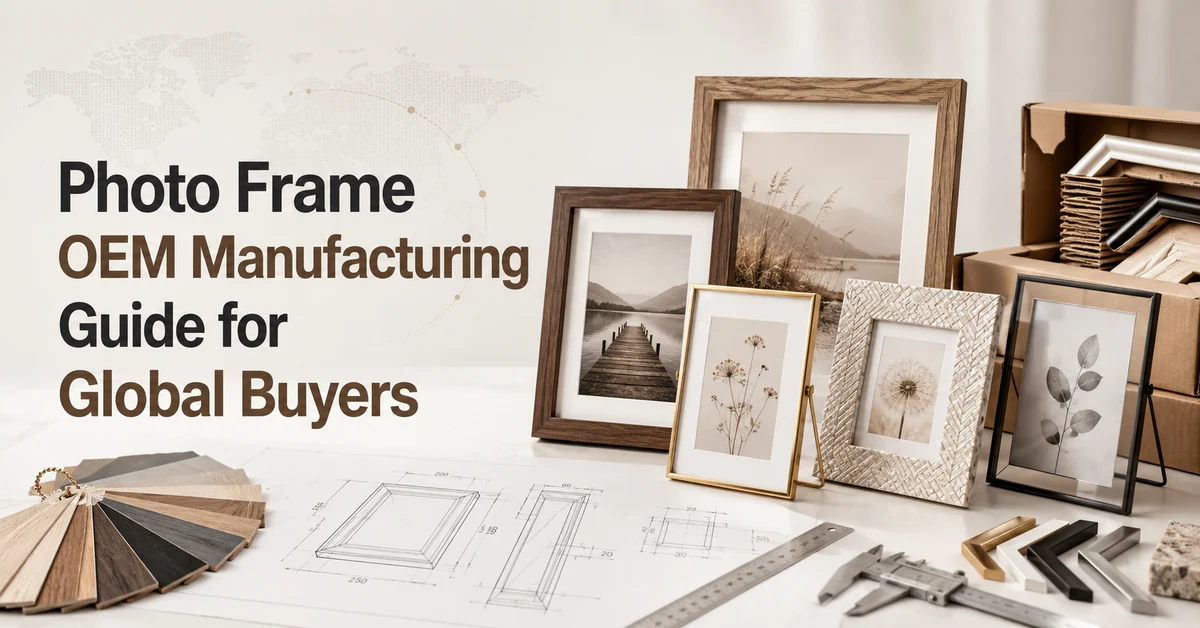

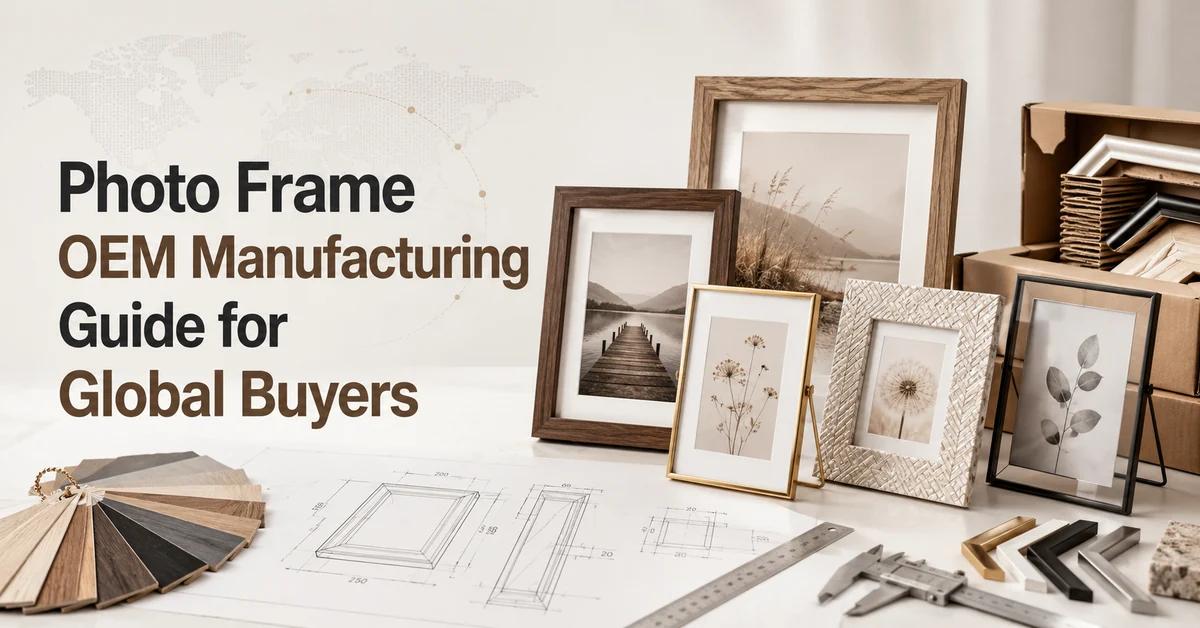
Photo frames are no longer simple household accessories. For retailers, gift brands, home décor importers, and private-label buyers, they are products that combine decoration, memory, packaging value, and emotional gifting.
A successful frame must look attractive, protect the photo, stand or hang securely, match the target interior style, survive international shipping, and remain consistent across repeated production batches.
This is why choosing a reliable photo frame OEM manufacturer is important for B2B buyers. The right manufacturing partner should support material selection, frame structure, custom design, surface finishing, backing hardware, glass or acrylic cover selection, quality control, packaging, and shipment planning.
As an OEM/ODM gift and home décor manufacturer, HoeGifts supports custom photo frame production for global buyers, including decorative frames, personalized frames, wholesale photo frames, seasonal gift frames, souvenir frames, licensed frame programs, and mixed-material home décor collections.
This guide explains how picture frame manufacturing works, what buyers should evaluate before placing a wholesale order, and how HoeGifts helps brands develop scalable, market-ready frame products.
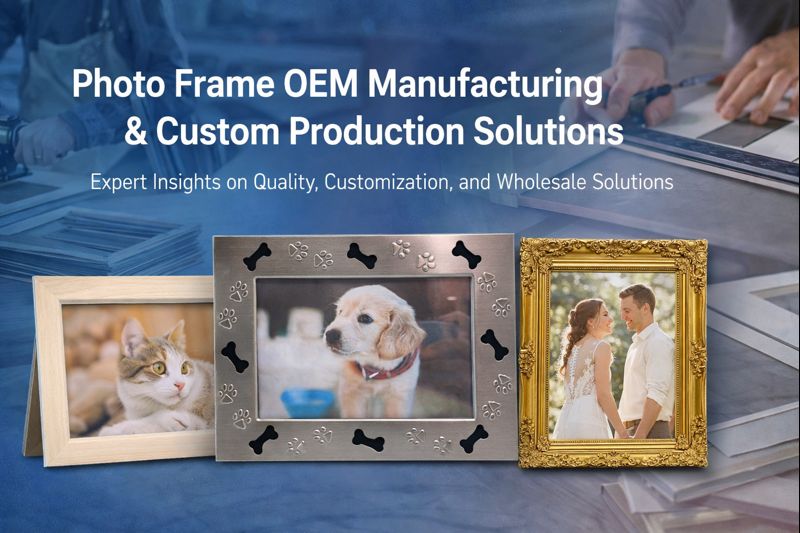
How Does a Photo Frame OEM Manufacturer Support Global Buyers?
A photo frame OEM manufacturer supports buyers by turning designs, reference samples, artwork, or product concepts into finished frames that can be produced consistently at scale.
The process usually includes:
- Product requirement review
- Material and structure selection
- Design feasibility analysis
- Sample development
- Surface finishing and decoration
- Hardware and backing assembly
- Quality inspection
- Retail and export packaging
- Bulk production and shipment coordination
For global buyers, the goal is not only to create a good-looking frame. The goal is to develop a frame that matches the target market, retail price, packaging format, and quality expectations.
Key Buying Considerations for Custom Photo Frames Wholesale
Before choosing a supplier, buyers should evaluate more than unit price.
| Buyer consideration | Why it matters | What to confirm |
|---|---|---|
| Material | Affects appearance, weight, cost, and durability | Wood, MDF, metal, zinc alloy, resin, acrylic, glass, or mixed materials |
| Frame structure | Impacts stability and long-term use | Corner joints, backing board, stand, hanger, clips |
| Cover material | Protects the photo and affects safety | Glass, acrylic, PET, or open-front design |
| Surface finish | Determines retail appeal | Painting, printing, plating, lamination, distressing, or coating |
| Customization | Supports brand differentiation | Logo, size, color, engraving, artwork, packaging |
| Packaging | Reduces breakage and improves retail presentation | Inner protection, retail box, gift box, export carton |
| MOQ | Affects trial orders and product-line planning | Existing design vs custom mold or tooling |
| Quality control | Protects repeat-order consistency | Golden sample, in-process checks, final inspection |
| Lead time | Determines launch schedule | Sampling, revision, production, and shipping timeline |
A low price does not always mean lower total cost. Poor construction, weak packaging, unstable color, or high return rates can make the project more expensive after shipment.
Understanding the Role of Photo Frames in Home Décor and Gift Markets
Photo frames serve several markets at the same time.
They may be used as:
- Home décor items
- Personalized gifts
- Wedding and anniversary gifts
- Baby and family keepsakes
- Corporate gifts
- Souvenirs
- Seasonal decorations
- Licensed merchandise
- Retail display collections
- Premium packaging add-ons
Because of this wide application, photo frame design must match both emotional value and commercial positioning.
A premium wedding frame may require refined metallic details, pearl-like accents, velvet backing, or a gift box. A mass-market home décor frame may need stable pricing, simplified construction, and efficient packaging. A souvenir frame may rely on printed artwork, regional motifs, or compact packaging for travel retail.
The manufacturer should understand the target channel before recommending material, structure, finish, and packaging.
Common Materials Used in Picture Frame Manufacturing
Material selection is one of the most important decisions in custom photo frame production. Each material has different advantages, limitations, cost implications, and quality-control points.
| Material | Main advantage | Common application | Key risk to control |
| Solid wood | Natural texture and premium feel | Mid-range and premium home décor | Warping, color variation, joint stability |
| MDF | Cost-effective and easy to finish | Mass-market and printed frames | Moisture sensitivity, edge quality |
| Metal | Slim structure and modern look | Contemporary décor and office frames | Scratches, coating consistency |
| Zinc alloy | Weight, detailed molding, premium decoration | Decorative and gift frames | Plating, casting defects, corrosion |
| Resin | Sculptural details and themed designs | Seasonal and novelty frames | Surface bubbles, color variation |
| Acrylic | Lightweight and modern appearance | Minimalist and display frames | Scratches, static marks |
| Glass | Clear photo protection and premium perception | Traditional and gift frames | Breakage, sharp edges, packaging |
| Mixed materials | Strong visual differentiation | Gift collections and seasonal décor | Adhesion, alignment, component interaction |
The best material is not always the most expensive one. It should be selected according to product use, retail price, weight, packaging, destination market, and target consumer.
Solid Wood and MDF Frames
Wooden and MDF frames are widely used in home décor because they offer warmth, versatility, and broad style compatibility.
Solid Wood Frames
Solid wood frames are suitable for buyers who want a natural appearance or premium positioning.
Common design directions include:
- Rustic
- Farmhouse
- Vintage
- Scandinavian
- Classic
- Natural home décor
Important quality points include:
- Wood moisture control
- Joint strength
- Surface sanding
- Color consistency
- Coating adhesion
- Backing fit
- Hanging hardware strength
Solid wood may show natural variation. Buyers should define whether this variation is acceptable or whether a more uniform finish is required.
MDF Frames
MDF is often selected for cost-effective picture frame manufacturing because it is stable, easy to cut, and suitable for painting, lamination, printing, or decorative coating.
MDF works well for:
- Mass retail frames
- Printed decorative frames
- Seasonal frame collections
- Promotional frames
- Low-to-mid price home décor products
Important controls include edge smoothness, coating quality, moisture protection, corner joints, and packaging.
Metal and Zinc Alloy Frames
Metal and zinc alloy frames are often used when buyers want a premium, modern, or decorative look.
Metal Frames
Metal frames can create a clean and contemporary appearance.
They are suitable for:
- Office décor
- Modern home décor
- Gallery-style frames
- Minimalist collections
- Slim-profile frame designs
Quality checks should focus on:
- Surface scratches
- Coating thickness
- Color consistency
- Corner alignment
- Sharp edges
- Hardware fit
Zinc Alloy Decorative Frames
Zinc alloy allows detailed shapes, raised patterns, enamel colors, and decorative finishes.
It is useful for:
- Gift frames
- Souvenir frames
- Wedding frames
- Licensed merchandise
- Premium desktop frames
Quality control should review casting defects, plating finish, enamel filling, decorative detail, corrosion resistance, backing assembly, and packaging protection.
Acrylic, Resin, and Mixed-Material Frames
Modern photo frame collections often combine multiple materials to create stronger visual appeal.
Acrylic offers a lightweight, clean, and modern look, while resin allows molded characters, patterns, or sculptural details. Mixed-material frames can combine wood, metal, glass, acrylic, fabric, ribbon, sand, or decorative accessories.
Common Mixed-Material Frame Risks
| Risk | Common cause | Recommended control |
| Loose decoration | Weak adhesive or poor surface preparation | Test assembled samples |
| Misaligned parts | No assembly guide or fixture | Use positioning references |
| Scratched surface | Acrylic or metal rubs during shipping | Add protective film or separator |
| Color mismatch | Materials finished in different processes | Approve full-product color sample |
| Weak stand | Back support not matched to frame weight | Test standing angle and stability |
| Packaging damage | Insert supports only frame body | Protect corners, cover, and decorations |
The complete assembled frame must be evaluated, not only the individual components.
Custom Photo Frames Wholesale: Customization Options
Custom photo frames wholesale programs allow brands and retailers to create unique product collections for different customer groups.
Customization may include:
- Frame size
- Frame shape
- Material
- Color
- Surface texture
- Logo
- Engraving
- Printing
- Decals
- Metallic finish
- Distressed finish
- Decorative accessories
- Backing board
- Stand or hanger
- Photo window size
- Retail packaging
- Gift box
- Barcode and label
Customization should be linked to the product’s commercial purpose.
For example, a corporate gift frame may need logo engraving and premium packaging. A wedding frame may need metallic details, soft colors, and sentimental text. A children’s frame may need bright colors, rounded edges, and playful shapes.
Personalized Frame Production for Gift and Retail Programs
Personalized frame production is valuable because photo frames are naturally emotional products. They are often connected with memories, family, relationships, milestones, and celebrations.
Personalized frames are commonly used for:
- Weddings
- Anniversaries
- Birthdays
- Baby gifts
- Graduation gifts
- Family keepsakes
- Travel souvenirs
- Corporate recognition
- Holiday gifts
- Licensed collections
Personalization options may include names, dates, messages, logos, symbols, patterns, regional artwork, or seasonal motifs.
However, personalization also increases production complexity. Buyers should confirm:
- Artwork format
- Font style
- Engraving depth
- Printing method
- Color tolerance
- SKU quantity
- Packaging label
- Order tracking method
- Approval process
For large wholesale programs, personalization should be standardized so the factory can produce efficiently without losing accuracy.
Picture Frame Manufacturing Process: From Design to Delivery
A structured manufacturing workflow helps reduce defects, delays, and unnecessary revisions.
Product Brief and Design Review
The buyer provides product information such as:
- Target market
- Product size
- Material preference
- Photo opening size
- Frame thickness
- Display method
- Surface finish
- Custom logo or artwork
- Packaging format
- Quantity
- Target price
- Required delivery date
HoeGifts reviews the brief to understand both design expectations and manufacturing requirements.
Material and Structure Selection
The manufacturing team evaluates the best material and frame structure according to:
- Product size
- Weight
- Cost target
- Retail channel
- Finishing method
- Packaging method
- Shipping route
- Intended use
This stage helps prevent problems such as weak corners, unstable stands, heavy freight cost, or fragile display structures.
Prototype Development
A physical sample is produced to confirm:
- Frame proportion
- Material
- Surface finish
- Color
- Decoration
- Backing structure
- Stand or hanging hardware
- Cover material
- Packaging fit
The first sample often requires adjustment. This is normal in OEM development.
Sample Revision and Golden Sample Approval
After the buyer reviews the prototype, the factory may adjust:
- Frame thickness
- Corner joint
- Surface color
- Decoration placement
- Backing fit
- Hardware type
- Packaging insert
- Carton quantity
Once approved, the final sample becomes the golden sample.
Bulk production should be compared against this physical reference rather than relying only on photos.
Bulk Production
Production may include cutting, molding, casting, polishing, painting, printing, plating, assembly, backing installation, cover installation, and packaging.
The exact process depends on the frame material and design.
Final Inspection and Packing
Finished frames are inspected for appearance, size, function, decoration, assembly, packaging, barcode, SKU, and carton information.
Quality Control for Photo Frame OEM Manufacturing
Photo frames require both visual and functional inspection.
| Inspection area | What to check |
| Frame body | Cracks, chips, dents, scratches, distortion |
| Corners | Joint gap, glue mark, alignment, strength |
| Surface finish | Color, coating, printing, plating, texture |
| Photo opening | Size accuracy and clean edge |
| Cover | Glass or acrylic fit, scratches, sharp edges |
| Backing board | Fit, flatness, clip strength, material quality |
| Stand | Angle, strength, stability |
| Hanger | Position, pull strength, installation accuracy |
| Decoration | Logo, engraving, beads, enamel, printed artwork |
| Packaging | Product movement, corner protection, barcode, carton strength |
For repeat orders, color and workmanship should be compared with the retained golden sample.
Packaging for Home Décor Frames
Packaging is especially important for photo frames because frames often include fragile covers, sharp corners, decorative finishes, or delicate surface coatings.
Common packaging options include:
- Protective corner guards
- Bubble bag
- Paper sleeve
- PET cover protection
- Individual white box
- Printed color box
- Window box
- Gift box
- Corrugated insert
- Foam insert
- Export carton
Packaging Questions Buyers Should Ask
- Does the frame move inside the box?
- Are corners protected?
- Is the glass or acrylic cover protected from scratches?
- Is the stand or hanger protected from bending?
- Can the packaging support stacking?
- Is the retail box suitable for shelf display?
- Are barcode and SKU labels clear?
- Is the carton weight manageable?
- Is the packaging suitable for e-commerce or only bulk shipment?
Packaging should be approved with the final finished frame, not only with an unfinished sample.
MOQ, Tooling, and Lead Time
MOQ depends on product design and production requirements.
Important factors include:
- Existing frame profile or custom mold
- Material
- Size
- Color
- Surface finish
- Decoration
- Logo
- Packaging
- Number of SKUs
- Manual assembly
- Hardware type
- Order schedule
A standard frame with custom printing may support a lower trial quantity. A fully custom zinc alloy frame, resin frame, or mixed-material frame normally requires higher MOQ because of tooling, mold setup, and material preparation.
Total Project Timeline
Buyers should plan for:
- Product concept
- Specification review
- Quotation
- Sample development
- Sample revision
- Golden sample approval
- Packaging approval
- Bulk production
- Final inspection
- Export packing
- Shipment
Production time should not be confused with total project time. Custom development requires enough time for sampling, revision, approval, packaging, and shipping.
Compliance and Safety Considerations
Compliance requirements depend on the frame material, destination market, intended user, and retailer requirements.
Possible review areas include:
- Paints and coatings
- Heavy-metal content
- Sharp edges
- Glass safety
- Small parts
- Magnet security
- Packaging labels
- Children’s product requirements
- Retailer-specific testing
Buyers should not assume that a raw material certificate covers the finished frame. Decoration, coating, adhesive, hardware, and packaging may all affect compliance requirements.
How to Choose a Home Décor Frame Supplier
A reliable home décor frame supplier should be able to support both product development and production execution.
Buyers should ask:
- What frame materials does the supplier work with?
- Does the supplier support custom sizes and shapes?
- Can it handle logo, engraving, printing, or decorative finishes?
- Can it produce mixed-material frames?
- How are frame corners and backing structures inspected?
- Can the supplier develop retail packaging?
- Are golden samples retained?
- How are repeat-order colors controlled?
- What is the MOQ for each design?
- How is production lead time calculated?
- Can the supplier manage multiple SKUs?
- How are defects handled during production?
- What information is needed for an accurate quotation?
A supplier that can explain risks early is usually more valuable than one that only confirms every request without review.
Common Risks in Custom Photo Frame Production
| Risk | Common cause | Prevention |
| Frame corner gaps | Poor cutting, weak assembly, material movement | Use stable process and corner inspection |
| Surface scratches | Handling or packaging friction | Add surface protection and packing checks |
| Color inconsistency | No approved physical color reference | Retain golden sample and color standard |
| Weak stand | Stand material or angle not suitable | Test standing stability |
| Glass breakage | Inadequate cover protection | Use proper inner protection |
| Decoration falls off | Weak adhesive or poor surface preparation | Test assembled product |
| Packaging damage | Retail box or carton too weak | Approve packed sample |
| MOQ misunderstanding | Custom tooling not confirmed | Define mold and material requirements early |
| Delivery delay | Sampling and packaging time omitted | Build a complete project schedule |
| Repeat order difference | No records retained | Keep drawings, samples, colors, and artwork |
OEM and ODM Opportunities for Photo Frame Collections
HoeGifts supports both OEM and ODM frame development.
OEM Photo Frame Manufacturing
OEM is suitable when the buyer already has:
- Product drawings
- Reference samples
- Artwork
- Dimensions
- Material requirements
- Packaging specifications
The factory’s role is to manufacture the approved design consistently.
ODM Photo Frame Development
ODM is suitable when the buyer has:
- A market idea
- Seasonal theme
- Target price
- Retail channel
- Style direction
- Product inspiration
HoeGifts can support concept development, material selection, sample development, structure review, cost optimization, and packaging planning.
Frequently Asked Questions About Photo Frame OEM Manufacturing
What Is a Photo Frame OEM Manufacturer?
A photo frame OEM manufacturer produces frames based on buyer-provided designs, samples, specifications, artwork, and packaging requirements.
What Types of Photo Frames Can HoeGifts Manufacture?
HoeGifts supports wooden frames, MDF frames, metal frames, zinc alloy frames, resin frames, acrylic frames, glass frames, decorative frames, and mixed-material frames.
Can Buyers Order Custom Photo Frames Wholesale?
Yes. Buyers can customize size, material, color, logo, surface finish, decoration, backing, hanger, stand, and packaging.
Does HoeGifts Support Personalized Frame Production?
Yes. Personalized frame options may include names, dates, logos, printed artwork, engraving, themed decoration, and custom packaging.
What Materials Are Best for Home Décor Frames?
The best material depends on price level, target style, durability, weight, packaging, and retail channel. Common options include wood, MDF, metal, zinc alloy, resin, acrylic, and glass.
Can HoeGifts Make Custom Sizes?
Yes. Custom sizes can be developed according to the buyer’s photo format, frame proportion, packaging requirement, and order quantity.
What Determines the MOQ?
MOQ depends on material, frame size, tooling, surface finish, decoration, packaging, SKU quantity, and production complexity.
How Are Photo Frame Samples Approved?
Buyers review the physical sample for dimensions, material, color, surface finish, decoration, backing, stand, hanger, cover, and packaging before confirming the golden sample.
How Does HoeGifts Control Photo Frame Quality?
Quality control may include material inspection, first-piece approval, in-process inspection, golden-sample comparison, and final inspection.
Can HoeGifts Develop Retail Packaging?
Yes. Packaging options may include white boxes, color boxes, window boxes, gift boxes, inserts, labels, barcodes, and export cartons.
What Information Should Buyers Provide for a Quotation?
Buyers should provide product references, dimensions, materials, quantity, customization details, packaging requirements, target market, and required delivery date.
Can HoeGifts Support Seasonal or Licensed Frame Programs?
Yes. HoeGifts can support seasonal, souvenir, gift, home décor, and licensed frame programs when product scope, artwork, authorization, and market requirements are clearly confirmed.
Conclusion: Custom Photo Frame Production Requires Design, Structure, and Control
A successful photo frame must do more than hold a picture.
It must support the buyer’s brand positioning, match the target retail channel, protect the photo, display securely, survive shipping, and remain consistent across production batches.
As a photo frame OEM manufacturer, custom photo frames wholesale supplier, personalized frame production partner, and home décor frame supplier, HoeGifts helps global buyers develop frame products through material selection, sample development, quality control, packaging, and scalable manufacturing.
For retailers, importers, distributors, gift brands, and private-label buyers planning a new frame collection, HoeGifts can support OEM/ODM development from product concept to final shipment.
Contact HoeGifts with your product reference, dimensions, material preference, estimated quantity, customization needs, packaging requirements, target market, and delivery date to receive a feasibility review and quotation.