

Sustainability conversations in the gift and packaging industries often begin with materials. Buyers ask whether a product is recyclable, whether it contains recycled content, or whether it can replace a disposable plastic component.
Those are useful questions, but they are not enough.
A material can be recyclable and still perform poorly if the product breaks quickly, uses an unsuitable coating, or combines several inseparable materials. Likewise, a durable metal component may support repeated use even when its initial manufacturing footprint is higher than that of a lightweight alternative.
Zinc alloy is a good example of this trade-off.
It is widely used for decorative gifts, souvenirs, photo frames, bathroom accessories, branded badges, packaging hardware, closures, buckles, and reusable presentation boxes. Its appeal comes from castability, surface detail, weight, strength, and the ability to carry a wide range of finishes.
For importers, gift brands, packaging developers, and OEM buyers, the real question is not simply, “Is zinc alloy sustainable?” The better question is:
How can zinc alloy products be designed, manufactured, finished, packed, and sourced in a way that improves durability and reduces unnecessary waste?
This guide examines the zinc alloy products manufacturing process through that practical lens. It also explains regional buyer priorities and the sourcing decisions that influence environmental performance.
Zinc Alloy in Sustainable Product Design & Eco Packaging Overview
Zinc alloy can support sustainable gift and eco packaging programs because it is durable, recoverable as metal scrap, suitable for precise die casting, and capable of replacing short-life decorative plastics in selected applications.
Its environmental performance depends on more than the base material. Buyers should also evaluate recycled input, casting yield, energy source, reject rate, surface finishing, component separation, packaging weight, transport distance, and expected product life.
For OEM projects, request measurable information rather than accepting broad claims such as “100% green” or “fully eco-friendly.”
Key Considerations for Sustainable Zinc Alloy Manufacturing & Sourcing
- Zinc alloy is well suited to durable, decorative, and reusable components.
- Recyclability does not guarantee that a finished product will actually be recycled.
- Good mold design reduces flash, scrap, machining, and rejected castings.
- Surface finishing is often the most environmentally sensitive production stage.
- Long product life can be more valuable than a low initial material weight.
- Regional buyers place different emphasis on documentation, luxury finishes, cost, and traceability.
- Sustainability claims should match the actual product, supply chain, and destination market.
What Is Zinc Alloy?
Zinc alloy is a zinc-based metal formulation that usually includes controlled amounts of aluminum, magnesium, copper, or other elements.
These additions improve casting behavior, strength, dimensional stability, and surface performance.
For decorative and functional products, zinc alloy is valued because molten metal flows into detailed mold cavities. This allows manufacturers to reproduce:
- Fine logos
- Raised lettering
- Decorative borders
- Textured surfaces
- Complex relief patterns
- Small functional features
- Thin-wall sections within suitable limits
The finished casting can then be polished, plated, painted, powder coated, printed, or assembled with wood, glass, silicone, fabric, acrylic, or paperboard.
This combination of detail and finish makes zinc alloy useful for products where appearance carries commercial value.
Where Zinc Alloy Fits in Sustainable Product Design
Zinc alloy should not be treated as a universal replacement for plastic, aluminum, stainless steel, or wood.
It works best where its durability, cast detail, weight, or premium feel provides a clear benefit.
| Application | Why Zinc Alloy Is Used | Sustainability Opportunity |
|---|---|---|
| Souvenir magnets | Fine detail and durable artwork | Longer life than disposable promotional items |
| Gift box hardware | Strong corners, locks, and clasps | Supports reusable presentation packaging |
| Branded badges | Clear logos and premium weight | Reusable branding component |
| Photo frames | Decorative casting and stable structure | Long display life |
| Bathroom accessories | Strength and corrosion-resistant finishes | Reduced replacement frequency |
| Bottle or box closures | Precise fit and repeated opening | Reusable packaging systems |
| Corporate gifts | Engraving and premium appearance | Long-term brand visibility |
| Decorative handles | Functional and visual value | Replaceable hardware on durable products |
The strongest environmental case usually appears when the metal component extends product life or allows repeated use.
A zinc alloy clasp on a disposable box offers limited environmental value. The same clasp on a reusable wooden or rigid presentation case may support years of use.
The Zinc Alloy Products Manufacturing Process
1. Alloy Selection and Incoming Material Control
The process begins with selecting a suitable zinc alloy grade.
The choice depends on:
- Mechanical requirements
- Surface finish
- Casting detail
- Wall thickness
- Corrosion conditions
- Assembly method
- Destination market
- Customer testing requirements
Using the wrong material can lead to porosity, cracking, plating defects, dimensional instability, or poor long-term performance.
From a sustainability standpoint, buyers should ask whether the factory controls alloy composition and separates production scrap. Clean runners, gates, and rejected castings may be returned to controlled metal recovery streams, subject to quality and process requirements.
Uncontrolled mixing of alloys can create quality problems. Recycled content is useful only when composition and contamination remain managed.
2. Tooling and Design for Efficient Casting
A die-casting mold determines far more than product shape.
Good tooling influences:
- Metal flow
- Air release
- Cooling speed
- Cycle time
- Surface quality
- Flash level
- Reject rate
- Tool life
Poor mold design can create air pockets, incomplete filling, sink marks, excessive trimming, and unstable dimensions.
Every rejected casting consumes material, machine time, labor, and finishing capacity. Reducing the defect rate is therefore both a quality objective and an environmental objective.
Before tooling, the manufacturer should review wall thickness, draft angles, undercuts, lettering depth, ribs, screw positions, and polishing areas.
A decorative design may look impressive in a rendering but be inefficient to cast. Small changes can reduce weight and defects without changing the visible design.
3. Melting and High-Pressure Die Casting
Zinc alloys melt at lower temperatures than several commonly used structural metals. This can reduce thermal energy requirements during melting, although actual energy use still depends on furnace efficiency, insulation, cycle control, production volume, and local electricity sources.
During high-pressure die casting, molten metal is injected into a steel mold. The metal cools rapidly and forms the product.
The process is well suited to volume production because it offers:
- Fast cycles
- Repeatable dimensions
- Detailed surfaces
- Multi-cavity tooling
- Limited secondary machining for well-designed parts
For sustainability-focused buyers, important factory questions include:
- How is furnace temperature controlled?
- Is idle energy use monitored?
- Are runners and gates separated?
- How are defective parts recorded?
- Is mold maintenance scheduled?
- What is the typical first-pass yield?
The answers reveal more than a generic statement about “energy-efficient production.”
4. Trimming, Grinding, and Polishing
After casting, gates and flash are removed. Parts may then be ground, polished, vibrated, or blasted before finishing.
This stage affects appearance and coating quality. It also creates metal dust, polishing residues, worn abrasive media, and labor requirements.
A well-designed casting requires less correction. Buyers should therefore avoid specifications that demand an unrealistic mirror finish on poorly accessible surfaces.
The product should be designed around the intended viewing angle. Polishing every hidden surface may add cost and waste without improving customer value.
5. Surface Finishing
Surface finishing is usually the most sensitive stage in sustainable zinc alloy manufacturing.
Common processes include:
- Electroplating
- Powder coating
- Wet painting
- PVD finishing
- Antique coloring
- Brushing
- Clear coating
- Enamel filling
Each method has different visual, technical, and environmental characteristics.
Electroplating
Electroplating can create chrome, nickel, brass, copper, black nickel, gold-tone, and antique finishes.
It provides attractive results but requires careful chemical management, rinsing, wastewater treatment, and worker controls.
Buyers should not accept “eco plating” as a complete specification. Ask what process is used, what chemical restrictions apply, how wastewater is treated, and whether the finished coating meets the relevant market requirements.
Powder Coating
Powder coating can provide durable color with limited solvent emissions. Overspray may sometimes be recoverable within a controlled process.
However, small decorative details and recessed areas may be difficult to coat evenly. The process is not automatically suitable for every gift component.
PVD
Physical vapor deposition can create thin, decorative metallic finishes with strong visual consistency. It may reduce reliance on some traditional wet-finishing steps, but it requires specialized equipment and suitable base preparation.
PVD is often appropriate for premium products, not necessarily low-cost mass-market gifts.
Painting and Enamel
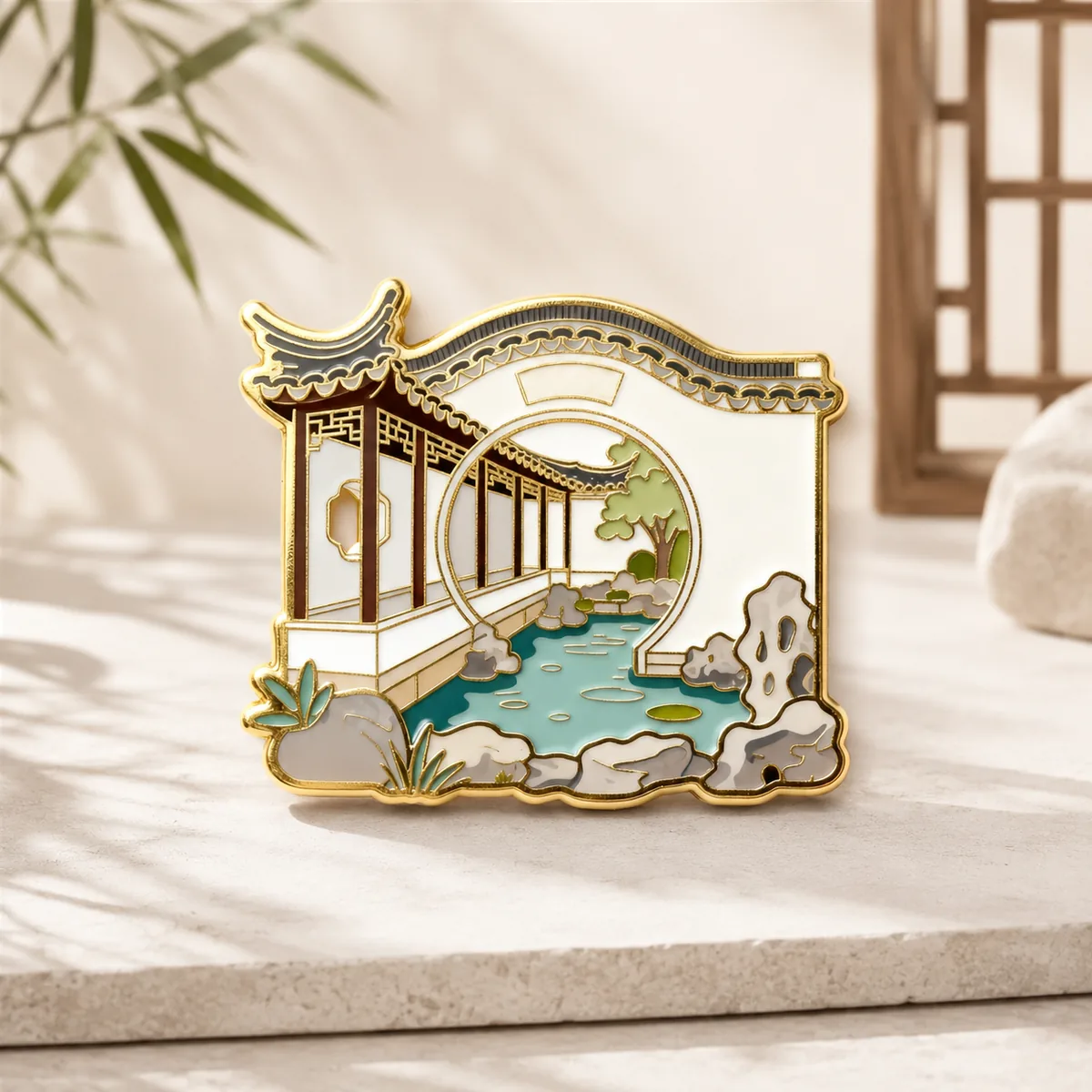
Paint, enamel, and printed decoration provide strong color flexibility. They are useful for magnets, badges, ornaments, and souvenirs.
Durability depends on surface cleaning, primer, ink or paint selection, curing, and top coating. A bright product that loses color after handling does not support a long-life sustainability claim.
Surface Finish Comparison
| Finish | Main Benefit | Main Risk | Typical Use |
| Electroplating | Premium metallic appearance | Chemical and wastewater control | Bathroom accessories and gift hardware |
| Powder coating | Durable color and limited solvent use | Coverage on fine details | Handles and home accessories |
| PVD | Refined metallic finish | Higher process cost | Premium gifts and lifestyle products |
| Wet painting | Wide color choice | Adhesion and solvent management | Decorative items |
| Enamel filling | Detailed multicolor artwork | Labor and curing consistency | Souvenirs and badges |
| Antique finish | Strong decorative character | Batch variation | Vintage gifts and frames |
Buyers should choose the finish based on expected handling, humidity, abrasion, and product life—not only the sample appearance.
Assembly and Design for Disassembly
Zinc alloy components are frequently combined with other materials.
Examples include:
- Metal locks on wooden boxes
- Zinc alloy borders on glass photo frames
- Decorative tags attached to paper packaging
- Metal pumps on glass dispensers
- Zinc alloy hooks with ceramic or resin parts
Mixed-material construction can create attractive products, but it may make recycling more difficult.
Where practical, components should be joined with screws, clips, or removable fittings rather than permanent adhesive. This can support repair, replacement, or material separation.
Not every gift product needs to be designed for complete disassembly. Still, the design team should at least consider whether the metal part can be removed without destroying the rest of the product.
Quality Control and Product Life
Durability is central to sustainable product development.
A product that lasts for years usually creates more value than one that must be replaced after a few months.
Useful zinc alloy quality checks include:
| Inspection Area | What to Check |
| Alloy and casting | Cracks, porosity, incomplete filling |
| Dimensions | Fit, assembly tolerance, hole position |
| Surface | Pits, scratches, polishing marks |
| Coating | Color, thickness, adhesion, corrosion performance |
| Function | Opening, closing, load, thread, hinge movement |
| Assembly | Screws, clips, adhesive, alignment |
| Artwork | Logo clarity, enamel filling, print position |
| Packaging | Surface protection and carton stability |
Testing should reflect the actual application.
Bathroom accessories may require humidity and corrosion testing. Gift box closures need cycle testing. Handles need pull or load testing. Magnets need adhesion checks and secure magnet assembly.
Sustainable Gifts and Eco Packaging Applications
Reusable Gift Boxes
A rigid paperboard or wooden gift box becomes more reusable when fitted with durable clasps, corners, hinges, handles, or nameplates.
The zinc alloy hardware should be designed for repeated opening and closing. A decorative lock that fails after several cycles undermines the purpose of reusable packaging.
Souvenirs and Branded Gifts
Magnets, badges, ornaments, and commemorative items can remain in use for years. This gives brands longer visibility than disposable promotional items.
The sustainability value comes mainly from durability and emotional retention, not simply from the presence of metal.
Bathroom and Lifestyle Accessories
Hooks, holders, frames, dispenser parts, and decorative fittings can support long service life when the alloy, coating, and assembly are appropriate for humid environments.
For these products, corrosion performance is more important than a general statement about recyclability.
Replaceable Packaging Components
Metal tags, buckles, and closures can be designed as removable parts. They may then be reused on another package or separated before recycling.
This is more credible than attaching a heavy metal decoration permanently to packaging intended for immediate disposal.
Regional Sustainability Priorities
Sustainability does not mean the same thing to every buyer. Regional expectations differ because of regulations, retail practices, consumer behavior, climate, and price structure.
Europe
European buyers often place strong emphasis on:
- Material documentation
- Chemical restrictions
- Supplier traceability
- Packaging reduction
- Recyclability claims
- Repair and product life
- Environmental management systems
Buyers may request REACH-related information, restricted-substance declarations, coating documentation, and packaging material details.
Unsupported green claims create commercial risk. Terms such as “zero impact,” “completely sustainable,” or “100% recyclable everywhere” should be avoided unless the claim can be verified for the finished product and actual market infrastructure.
North America
North American buyers commonly focus on:
- Product safety
- Retailer-specific compliance
- California-related chemical reviews where applicable
- Packaging efficiency
- E-commerce durability
- Recycled-content claims
- Clear consumer labeling
For online retail, shipping damage can be a larger issue than material weight alone. A durable zinc alloy gift still needs packaging that protects the finish without using excessive foam or plastic.
Middle East
In many Middle Eastern gift and hospitality markets, visual quality and durability remain strong priorities.
Popular requirements may include:
- Gold-tone or brass-tone finishes
- Premium presentation
- Humidity and corrosion resistance
- Custom logos
- Luxury gift packaging
- Hotel and corporate project consistency
Sustainability positioning is increasingly relevant, but it must coexist with premium appearance. Long product life, reusable presentation boxes, and durable PVD or plated finishes can support this balance.
Asia-Pacific
Asia-Pacific includes highly diverse markets.
Some buyers prioritize price and scale, while others focus on premium design, minimal packaging, or strict retail compliance.
Typical purchasing considerations include:
- Production efficiency
- Flexible MOQ
- Rapid product development
- Mixed-SKU programs
- Competitive tooling
- Recycled packaging
- Reliable replenishment
The region also contains much of the global zinc die-casting supply base. This creates sourcing advantages, but buyers still need to distinguish between factories with controlled material and finishing systems and suppliers that rely heavily on unverified subcontracting.
Latin America and Africa
In many emerging markets, durability, repairability, price, and logistics efficiency can be more important than sophisticated environmental labeling.
Products should tolerate:
- Long distribution routes
- Warehouse variation
- Humid or coastal conditions
- Limited replacement support
- Cost-sensitive retail structures
A long-lasting product with simple packaging may create more practical value than an elaborate sustainability story that raises cost without improving performance.
Regional Buyer Priority Table
| Region | Common Priorities | Supplier Preparation |
| Europe | Traceability, chemical compliance, claims control | Material records and clear declarations |
| North America | Retail compliance, shipping durability, labeling | Test reports and e-commerce packaging |
| Middle East | Luxury finish, corrosion resistance, presentation | Finish samples and humidity testing |
| Asia-Pacific | Cost, flexibility, scale, fast development | Clear MOQ and production planning |
| Latin America | Durability and landed cost | Strong packaging and simple specifications |
| Africa | Product life and logistics resilience | Corrosion protection and dependable supply |
These are broad purchasing patterns, not fixed rules. Every buyer should confirm the actual retailer, country, product category, and sales channel.
OEM and ODM Development Process
A practical OEM process should include:
- Product application and market review
- Material and alloy recommendation
- 2D or 3D drawing
- Tooling and finish quotation
- Prototype or mold sample
- Surface treatment approval
- Functional and packaging tests
- Golden sample confirmation
- Bulk casting and finishing
- Final inspection and shipment
Sustainability requirements should be introduced at the beginning.
Changing packaging, coating, recycled-content targets, or assembly methods after tooling can increase cost and delay the project.
MOQ, Cost, and Lead-Time Factors
Zinc alloy project cost is influenced by:
- Product weight
- Alloy grade
- Mold complexity
- Number of cavities
- Casting cycle
- Polishing requirements
- Finish type
- Number of colors
- Assembly
- Testing
- Packaging
- Order quantity
The lowest-weight design is not always best. Excessive thinning can create casting defects or reduce strength.
The goal is efficient material use without compromising function.
Lead time should account for mold development, mold trials, finishing samples, corrosion or adhesion tests, packaging approval, production, inspection, and freight.
How to Evaluate a Sustainable Zinc Alloy Supplier
Ask suppliers for specific evidence rather than marketing language.
Useful questions include:
- Which zinc alloy grade will be used?
- Is production scrap separated by material?
- What is the normal casting reject rate?
- Which finishing processes are completed in-house?
- How is plating wastewater managed?
- Can the supplier provide coating and material documentation?
- Is an environmental management system in place?
- Can the product be redesigned to reduce weight or simplify assembly?
- Can plastic packaging be reduced?
- Is the master sample retained for repeat orders?
- How are subcontractors audited?
- What sustainability claims can be supported with evidence?
A supplier does not need to have a perfect answer to every question. Transparency is more valuable than vague promises.
Common Sustainability Risks
| Risk | Why It Happens | Better Approach |
| Unsupported green claims | Marketing exceeds evidence | Use specific and limited wording |
| Excessive product weight | Design is not optimized | Review wall thickness before tooling |
| High coating failure | Finish does not match use | Test adhesion and corrosion |
| Difficult recycling | Components cannot be separated | Use removable assembly where practical |
| Excessive packaging | Protection added without testing | Validate a lighter packing structure |
| High reject rate | Poor mold or process control | Track defects and maintain tooling |
| Short service life | Weak coating or hardware | Test the complete product |
| Unclear recycled content | Supplier lacks traceability | Request documented material inputs |
Frequently Asked Questions
1. Is zinc alloy recyclable?
Yes, zinc alloys can be recovered and recycled through suitable metal recycling systems. Actual recovery depends on collection, separation, coatings, product design, and local infrastructure.
2. Does zinc alloy contain recycled material?
It may contain secondary metal, but the percentage varies by supplier and alloy requirements. Buyers should request documented information when recycled content is part of the product claim.
3. Is zinc alloy more sustainable than plastic?
Not in every application. Zinc alloy may be preferable for durable, reusable, or premium components. Plastic may be more efficient for lightweight short-distance applications. The complete life cycle matters.
4. What sustainable gifts can use zinc alloy?
Common examples include reusable gift box hardware, souvenirs, badges, photo frames, awards, bottle accessories, bathroom gift sets, and branded decorative components.
5. Can zinc alloy be used in eco packaging?
Yes, especially for durable closures, nameplates, corners, handles, and reusable packaging hardware. It is less suitable when attached to disposable packaging without a reuse or separation plan.
6. Which surface finish is the most environmentally friendly?
There is no universal answer. The best option depends on durability, process controls, chemical management, product life, and factory wastewater or emission systems.
7. Is powder coating better than electroplating?
Powder coating may reduce solvent use and provide durable color, but it cannot create every metallic appearance. Electroplating may be appropriate when properly managed and when the finish extends product life.
8. What should European buyers request?
Depending on the product, buyers may request material declarations, REACH-related information, coating documentation, packaging details, and evidence supporting environmental claims.
9. How can product weight be reduced?
Manufacturers can review wall thickness, internal ribs, hollow sections, and non-visible areas. Weight reduction must not create casting defects or weaken the product.
10. How can packaging be made more sustainable?
Use accurately sized cartons, recyclable paper inserts, reduced plastic wrapping, efficient master-carton loading, and tested protection rather than excessive cushioning.
11. What is the main environmental risk in zinc alloy production?
Surface finishing, energy use, rejects, wastewater, and poor process control can have significant impacts. Buyers should review the entire production chain.
12. What should be approved before bulk production?
Approve the alloy, dimensions, weight, surface finish, color, function, assembly, packaging, test requirements, and physical golden sample.
Conclusion
Zinc alloy can play a useful role in sustainable gift solutions and eco packaging, but the material should not be promoted through recyclability alone.
Its real value comes from a combination of precision, durability, repair potential, premium appearance, and long service life.
For buyers, the zinc alloy products manufacturing process should be reviewed as a complete system: alloy sourcing, mold design, casting yield, polishing, finishing, assembly, packaging, testing, and logistics.
Regional expectations also matter. European buyers may focus heavily on traceability and claims. North American buyers may prioritize retailer compliance and e-commerce packaging. Middle Eastern projects often require premium finishes and corrosion resistance. Asia-Pacific programs frequently balance scale, flexibility, and cost.
Before starting an OEM project, prepare the target market, product application, estimated quantity, finish requirement, packaging concept, compliance list, and sustainability claims you intend to make.
Then ask the supplier to review which claims can actually be supported.
A credible sustainable product is not the one with the strongest environmental slogan. It is the one designed to last, manufactured with controlled processes, packed efficiently, and described honestly.