
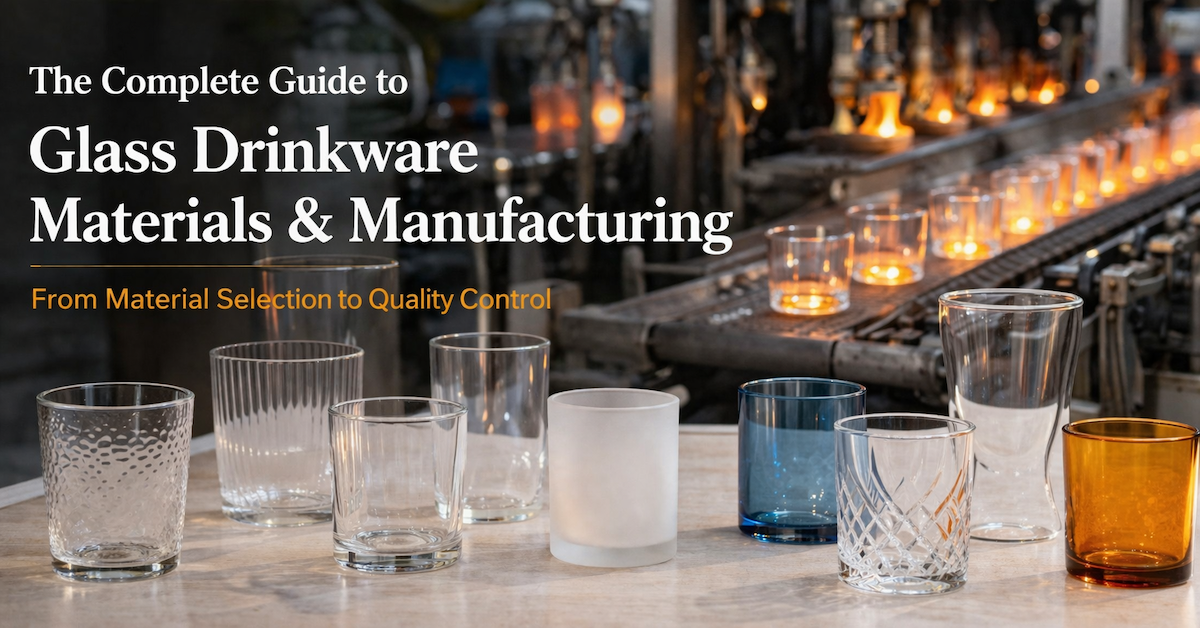

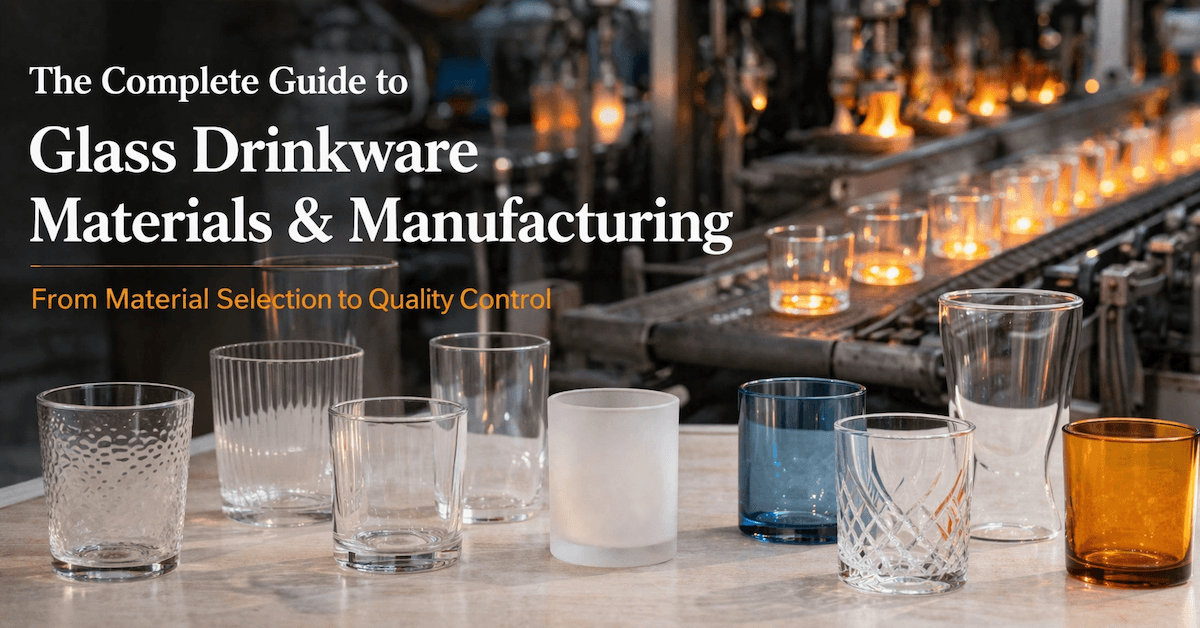
Choosing the right material is one of the most important decisions in glass drinkware development.
For retailers, café brands, hospitality suppliers, importers, and private-label buyers, a glass cup is not only a container for beverages. It also affects product safety, user experience, brand perception, packaging cost, breakage rate, retail positioning, and long-term customer satisfaction.
A clear Glass Drinkware Material Selection Guide helps buyers compare different glass types, understand the production process, evaluate customization options, and avoid common sourcing mistakes before bulk production begins.
This guide explains how to choose between soda-lime glass, borosilicate glass, and crystal glass, how modern glassware is manufactured, why quality control matters, and how custom glass cup production can support brand differentiation.
Why Glass Drinkware Material Selection Matters
Glass drinkware appears simple from the outside, but material choice directly affects performance.
The same cup shape may perform very differently depending on the glass type, wall thickness, forming method, annealing control, decoration process, and packaging structure.
Before selecting a material, B2B buyers should confirm:
- Intended beverage use
- Hot or cold application
- Target retail price
- Required durability
- Product weight
- Transparency requirement
- Logo or decoration method
- Packaging format
- Order quantity
- Destination market
- Expected customer use scenario
A cup for iced drinks in a café does not need the same material performance as a double-wall tea cup. A promotional tumbler may prioritize cost efficiency, while a premium retail gift set may need better clarity, lighter structure, and more refined packaging.
Material choice should therefore match the full commercial purpose of the product.

Common Glass Drinkware Materials
Most glass drinkware products use one of the following materials:
| Material | Main Advantage | Main Limitation | Suitable Products |
|---|---|---|---|
| Soda-lime glass | Cost-effective and widely available | Moderate thermal shock resistance | Everyday cups, beer mugs, retail drinkware |
| Borosilicate glass | Better heat resistance and lightweight feel | Higher production cost | Tea cups, coffee cups, double-wall drinkware |
| Lead-free crystal glass | High clarity and premium appearance | Higher cost and more careful handling | Giftware, barware, premium glassware |
| Colored glass | Strong decorative value | Batch color consistency must be controlled | Lifestyle drinkware and gift cups |
| Recycled-content glass | Supports sustainability positioning | Appearance depends on process control | Eco-focused glassware programs |
The best choice is not always the most expensive material. It is the material that matches the buyer’s use case, price point, packaging plan, and quality expectations.
Borosilicate vs Soda Lime Glass Cups
One of the most common sourcing questions is how to compare Borosilicate vs Soda Lime Glass Cups.
Both materials are widely used, but they serve different market needs.
Soda-Lime Glass Cups
Soda-lime glass is the most common material for everyday drinkware. It is widely used because it offers stable production, good clarity, and competitive cost.
It is suitable for:
- Water glasses
- Juice cups
- Beer mugs
- Retail drinkware sets
- Promotional glass cups
- Hospitality glassware
For large-volume retail or food-service programs, soda-lime glass is often a practical choice. It allows buyers to control unit cost while maintaining acceptable appearance and usability.
However, soda-lime glass is generally less resistant to sudden temperature changes. If the cup will be used for very hot beverages, the manufacturer should review the product structure carefully.
Borosilicate Glass Cups
Borosilicate glass cups are valued for stronger resistance to temperature changes, lightweight structure, and clean visual appearance.
They are suitable for:
- Tea cups
- Coffee cups
- Double-wall cups
- Premium drinkware
- Lifestyle glassware
- Gift-ready cup sets
Borosilicate glass is often preferred when the product needs a refined look or better thermal performance. It is especially useful for premium drinkware lines where the buyer wants to communicate quality and comfort.
Material Comparison
| Factor | Soda-Lime Glass | Borosilicate Glass |
| Cost | Lower | Higher |
| Heat resistance | Moderate | Better |
| Weight | Usually heavier | Often lighter |
| Production scale | Strong for mass production | More suitable for premium lines |
| Visual positioning | Everyday and practical | Modern and premium |
| Best use | Cold drinks and general use | Hot drinks, tea, coffee, premium gifts |
For buyers, the decision should not be based only on material reputation. The correct choice depends on product use, target market, expected price, and packaging requirements.
Glass Drinkware Material Selection Guide for B2B Buyers
A practical Glass Drinkware Material Selection Guide should start with commercial positioning.
For Everyday Retail Drinkware
Choose soda-lime glass when the project needs:
- Competitive pricing
- Large production volume
- Simple shapes
- Standard packaging
- Stable repeat supply
This is often suitable for supermarkets, distributors, hospitality suppliers, and promotional product buyers.
For Premium Drinkware
Choose borosilicate glass or lead-free crystal glass when the project needs:
- Better perceived value
- Lightweight structure
- Heat resistance
- Refined transparency
- Gift-ready positioning
- Higher retail price
This is suitable for lifestyle brands, premium café products, specialty retailers, and gift collections.
For Decorative or Lifestyle Cups
Consider colored glass, gradient finishes, frosting, decals, or custom packaging when the buyer wants:
- Stronger shelf appeal
- Brand differentiation
- Seasonal collection value
- E-commerce photography impact
- Private-label customization
In these projects, appearance and packaging may be just as important as material performance.
Advanced Glass Manufacturing Technology
Modern glass cup production is no longer limited to simple manual forming. Many factories now use Advanced Glass Manufacturing Technology to improve consistency, production efficiency, and quality control.
Advanced glass production may include:
- Automated forming systems
- Precision mold control
- Controlled melting and refining
- Temperature monitoring
- Consistent wall-thickness control
- Digital inspection support
- Improved annealing systems
- More efficient production planning
For B2B buyers, advanced manufacturing technology matters because it helps reduce variation across large production runs.
A sample may look good, but bulk production is the real test. If the supplier cannot control forming, cooling, finishing, and inspection consistently, the final order may show problems such as uneven thickness, unstable capacity, rough rims, decoration defects, or higher breakage rates.
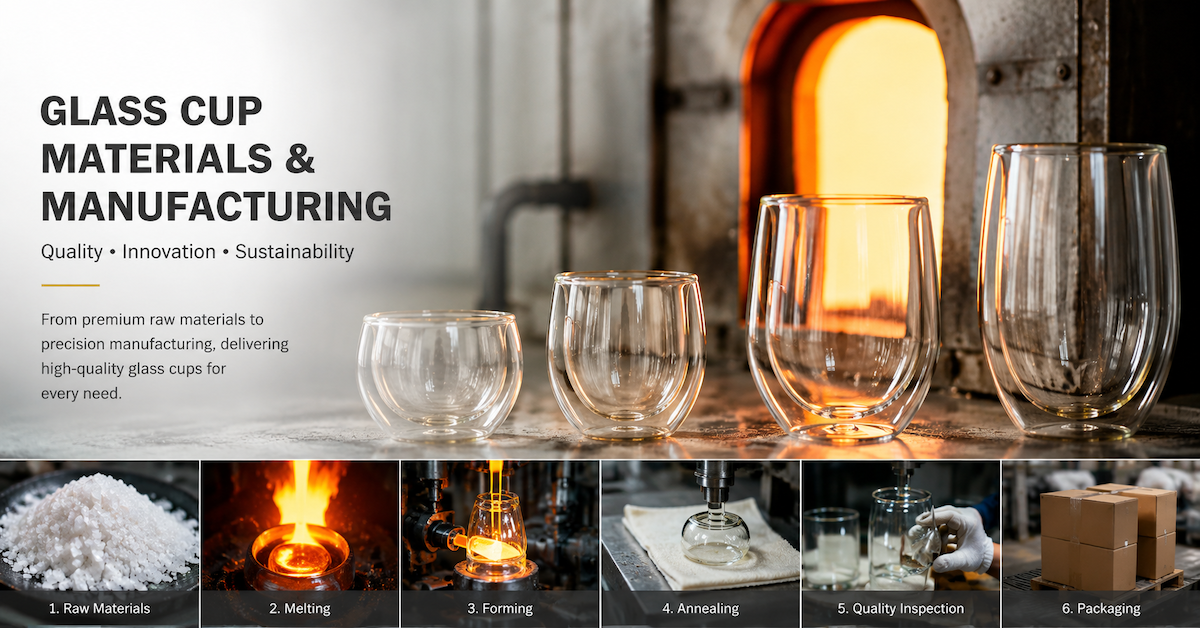
Glassware Production Process
The glassware production process usually includes several connected stages.
Raw Material Preparation
Glass production begins with raw materials such as silica sand, soda ash, limestone, borates, and recycled glass where suitable.
The material formula affects:
- Clarity
- Color tone
- Strength
- Thermal performance
- Melting behavior
- Production consistency
Buyers should confirm the intended material before sampling because material changes later may affect cost, MOQ, lead time, and testing requirements.
Melting and Refining
The raw materials are melted at high temperature until they become molten glass.
During this stage, impurities and bubbles must be controlled. Poor melting or refining can lead to visible defects, unstable color, or weaker product performance.
Forming
Molten glass is formed into the desired cup shape through blowing, pressing, molding, or automated forming.
During forming, the manufacturer must control:
- Cup height
- Diameter
- Capacity
- Wall thickness
- Rim structure
- Base stability
- Handle position if applicable
- Mold details
This stage determines much of the product’s final appearance and usability.
Annealing
Annealing is the controlled cooling process that reduces internal stress in glass products.
Improper annealing may cause glass cups to crack during decoration, packing, shipping, or customer use. This is especially important for thick-base cups, handled mugs, and borosilicate glass products.
Finishing and Decoration
After forming and annealing, the product may go through:
- Rim polishing
- Surface cleaning
- Logo printing
- Laser engraving
- Frosting
- Decal decoration
- Color spraying
- Metallic detailing
- Packaging preparation
Decoration should match the actual usage environment. A commercial glass cup used daily in a restaurant may require stronger decoration durability than a decorative gift cup used occasionally.
Custom Glass Cup Production Process
The Custom Glass Cup Production Process allows buyers to create exclusive drinkware products based on brand identity, market positioning, and customer needs.
A typical custom project includes:
| Stage | Key Work |
| Product brief | Confirm use, material, capacity, target market, and packaging |
| Feasibility review | Check structure, mold, material, decoration, and risk |
| Quotation | Confirm price, MOQ, tooling, and lead time |
| Sample development | Produce physical sample for buyer review |
| Sample revision | Adjust shape, color, logo, thickness, or packaging |
| Golden sample approval | Lock final product and quality standard |
| Bulk production | Manufacture according to approved sample |
| Quality inspection | Check appearance, capacity, logo, and packaging |
| Shipment preparation | Prepare cartons, labels, and export packing |
Custom glass cup production may include:
- Custom shape
- Custom capacity
- Custom thickness
- Logo printing
- Engraving
- Frosted finish
- Color coating
- Gift box packaging
- Barcode labels
- Private-label branding
For brand owners, customization helps avoid direct price competition. For retailers and importers, it creates exclusive collections that are easier to merchandise and reorder.
Quality Control in Glassware Manufacturing
Strong Quality Control in Glassware Manufacturing is essential because glass cups are directly touched, washed, used, displayed, and inspected by consumers.
Quality control should not happen only at final inspection. It should be built into the full production process.
Incoming Material Inspection
The supplier should check raw materials, packaging materials, decoration materials, lids, straws, and accessories where applicable.
First-Piece Approval
Before full production continues, the first production pieces should be compared with the approved sample.
This helps identify incorrect settings, wrong logo placement, color mismatch, or shape variation early.
In-Process Inspection
During production, the factory should check:
- Glass clarity
- Wall thickness
- Rim condition
- Capacity
- Base stability
- Surface defects
- Decoration accuracy
- Color consistency
Final Inspection
Before shipment, finished products should be reviewed for:
| Inspection Area | What to Check |
| Appearance | Cracks, chips, bubbles, scratches, cloudiness |
| Rim | Smooth, even, and safe for drinking |
| Capacity | Matches approved specification |
| Base | Stable and balanced |
| Decoration | Logo, artwork, color, position, and durability |
| Packaging | Protection, quantity, labels, and carton marks |
| Final standard | Compared with approved golden sample |
For custom glass cup OEM projects, logo accuracy and packaging consistency are especially important. A wrong logo, unclear print, or weak carton structure can make the product unsuitable for retail or promotion.
Packaging for Glass Drinkware
Packaging is part of the product solution, not just a shipping detail.
Glass cups are fragile, so packaging must balance protection, presentation, and cost.
Common packaging options include:
- Bulk carton packing
- Individual white box
- Kraft box
- Color box
- Window box
- Gift box
- Corrugated divider
- Molded pulp insert
- Foam insert
- Export carton
For e-commerce and gift programs, individual protection is especially important. For hospitality or bulk wholesale orders, carton efficiency and breakage protection may be more important than gift presentation.
Buyers should approve packaging with the final product sample. A blank cup may fit the box, but a decorated cup, handled mug, lid set, or straw set may require different inner protection.
Sustainability in Glass Drinkware Production
Sustainability is becoming an important part of glass drinkware sourcing.
Glass has strong sustainability potential because it can be reused and recycled when properly collected and processed. However, sustainable sourcing should be based on real product and packaging decisions rather than broad claims.
Sustainable glass drinkware development may include:
- Durable product design
- Reusable cup structures
- Recycled glass content where suitable
- Reduced production waste
- Plastic-reduced packaging
- Recyclable paper packaging
- Efficient carton design
- Longer product life
For B2B buyers, sustainability should not reduce product protection. If packaging is reduced too much and causes breakage, the result may create more waste and higher cost.
The best approach is to improve material use, product durability, and packaging efficiency together.
Common Sourcing Risks
| Risk | Common Cause | Recommended Control |
| Wrong material choice | Use case not clearly defined | Confirm hot or cold drink application early |
| Breakage during shipping | Weak packaging or carton structure | Test packaging with finished samples |
| Capacity mismatch | Specification not confirmed before sampling | Measure sample before approval |
| Logo defect | Artwork or decoration method not reviewed | Approve physical decoration sample |
| Rim quality issue | Poor finishing control | Inspect rim smoothness carefully |
| Thermal cracking | Material not suitable for use condition | Compare borosilicate and soda-lime options |
| Color inconsistency | No physical color reference | Retain golden sample |
| Late delivery | Sampling or packaging approval delayed | Plan full project timeline early |
A reliable supplier should help buyers identify these risks before bulk production begins.
How to Choose a Glass Cup Manufacturing Partner
Before selecting a glass cup supplier, buyers should ask:
- What glass materials are available?
- Can the supplier explain borosilicate vs soda-lime glass cups?
- What glassware production process is used?
- Can the supplier support custom glass cup production?
- What logo and decoration methods are available?
- Can samples be made before bulk production?
- How is capacity checked?
- How is rim quality inspected?
- What packaging options are available?
- How is quality control managed?
- Can the supplier support sustainable packaging?
- What affects MOQ and lead time?
A strong manufacturing partner should provide practical technical advice, not only product photos and price.
Frequently Asked Questions
What Is a Glass Drinkware Material Selection Guide?
A Glass Drinkware Material Selection Guide helps buyers compare glass materials such as soda-lime glass, borosilicate glass, crystal glass, colored glass, and recycled-content glass according to product use, price level, durability, heat resistance, and market positioning.
What Is the Difference Between Borosilicate and Soda-Lime Glass Cups?
Borosilicate glass cups offer better thermal shock resistance and a lighter, refined feel. Soda-lime glass cups are more cost-effective and suitable for many everyday drinkware and mass-retail programs.
What Is Advanced Glass Manufacturing Technology?
Advanced Glass Manufacturing Technology refers to production systems that improve consistency, efficiency, and quality, such as automated forming, temperature control, precision molds, and digital inspection support.
What Is the Custom Glass Cup Production Process?
The Custom Glass Cup Production Process includes product brief review, material selection, feasibility checking, sample development, decoration approval, golden sample confirmation, bulk production, quality inspection, and packaging.
Why Is Quality Control Important in Glassware Manufacturing?
Quality Control in Glassware Manufacturing helps prevent cracks, chips, rim defects, capacity errors, logo problems, packaging failures, and repeat-order inconsistency.
Can Glass Cups Be Customized with Logos?
Yes. Common logo methods include screen printing, laser engraving, frosted decoration, decals, UV printing, and custom packaging.
What Packaging Is Suitable for Glass Drinkware?
Glass drinkware may use individual boxes, gift boxes, molded pulp inserts, corrugated dividers, foam inserts, or export cartons depending on product fragility and sales channel.
What Information Should Buyers Provide for a Quotation?
Buyers should provide product reference, material preference, capacity, dimensions, quantity, logo artwork, decoration method, packaging requirement, target market, and delivery date.
Conclusion
Successful glass cup development requires more than choosing a nice shape.
B2B buyers need to understand glass drinkware material selection, compare borosilicate vs soda-lime glass cups, evaluate advanced glass manufacturing technology, plan a practical custom glass cup production process, and confirm quality control in glassware manufacturing.
Each decision affects product performance, pricing, packaging, production stability, and customer satisfaction.
As a glassware and gift product manufacturer, HoeGifts supports global buyers with material review, custom glass cup OEM development, logo decoration, packaging solutions, quality inspection, and scalable production.
Contact HoeGifts with your glass cup design, material preference, capacity, quantity, logo artwork, packaging requirements, and delivery schedule to receive a feasibility review and quotation.