
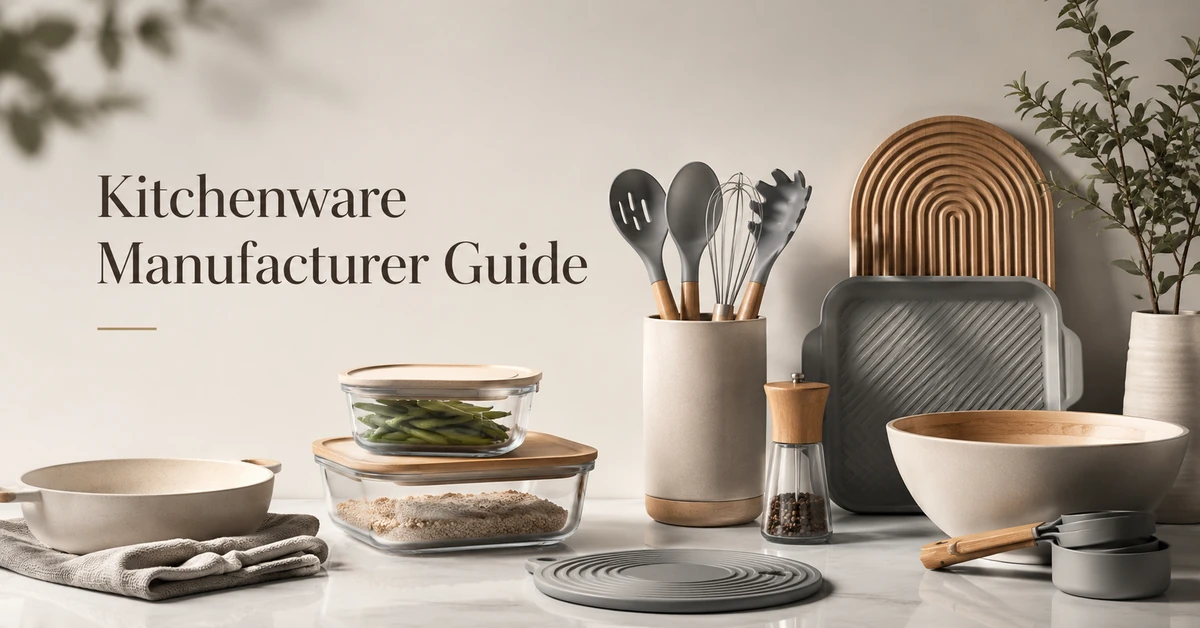

Choosing a kitchenware manufacturer is not only about finding a low unit price.
For retailers, importers, supermarket buyers, homeware brands, promotional gift companies, and private-label kitchenware buyers, the real question is whether the supplier can turn a product idea into stable, safe, retail-ready goods.
Kitchenware is used in daily life. It may touch food, handle heat, carry weight, support cooking, or appear in a gift set. A poor product can create returns, customer complaints, packaging damage, or compliance risk.
That is why buyers need to evaluate a kitchenware supplier from several angles: materials, production process, customization ability, packaging, MOQ, lead time, quality control, and export experience.
This guide explains how to choose a reliable kitchenware manufacturer, when to use custom kitchenware OEM service, how wholesale kitchenware projects are planned, and what makes a private label kitchenware supplier suitable for long-term cooperation.
What Makes a Reliable Kitchenware Manufacturer?
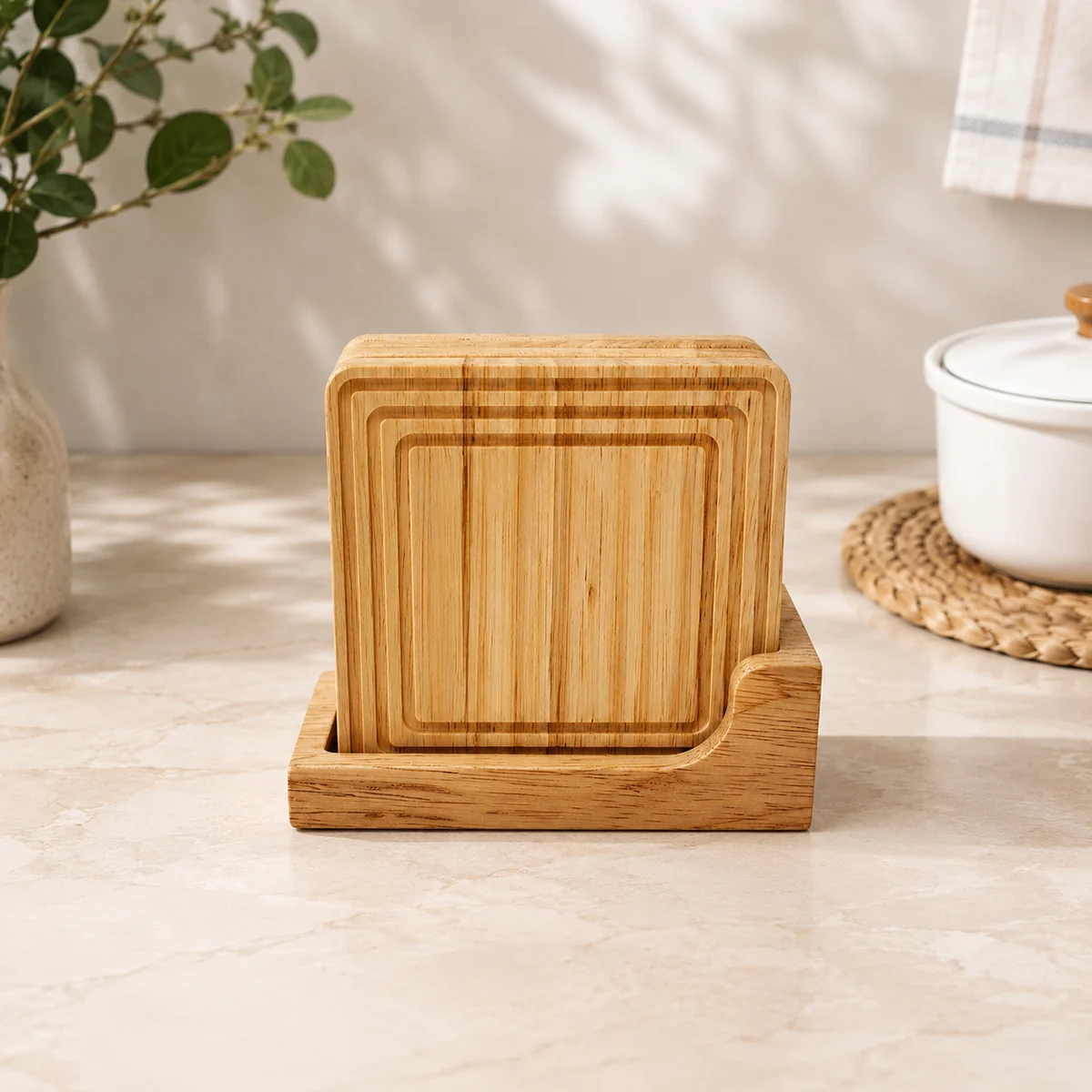
A reliable kitchenware manufacturer should provide more than product photos and a price list. It should help buyers review materials, product structure, food-contact requirements, logo methods, packaging protection, MOQ, lead time, and quality standards before bulk production. For custom kitchenware OEM and private label kitchenware projects, buyers should request samples, approve a golden sample, confirm packaging, and check quality control procedures before placing a large wholesale order.
Key Takeaways for Kitchenware Buyers
- A kitchenware manufacturer should be evaluated by material knowledge, production control, customization support, packaging ability, and quality inspection.
- A kitchenware supplier may offer existing products, but a factory partner should also help with sampling, mold review, packaging, and repeat-order consistency.
- Custom kitchenware OEM projects require clear drawings, material specifications, logo artwork, packaging requirements, MOQ planning, and sample approval.
- Wholesale kitchenware orders should balance price, durability, packaging volume, carton strength, and delivery schedule.
- A private label kitchenware supplier should support brand packaging, barcode labels, gift boxes, instruction cards, and stable quality control.
- Buyers sourcing from a kitchenware factory China should confirm food-contact documents, export packing, inspection standards, and communication workflow early.
Why Kitchenware Sourcing Is Different from General Gift Sourcing
Kitchenware products are practical items. Consumers do not only look at appearance. They touch, wash, store, heat, carry, and use them repeatedly.
This means buyers must consider real-use performance.
A silicone spoon should not feel too soft when stirring food. A wooden trivet should stay flat on the table. A glass cup should have a smooth rim. A kitchen storage item should fit easily into cabinets or shelves. A gift set should arrive without scratches, odor, broken packaging, or missing parts.
For B2B buyers, kitchenware sourcing usually involves five concerns:
| Buyer Concern | Why It Matters |
|---|---|
| Material safety | Kitchenware may contact food or drink |
| Durability | Products are used repeatedly and washed often |
| Function | The item must work as intended, not only look good |
| Packaging | Kitchenware can be fragile, heavy, or sold as a gift set |
| Consistency | Retail and private-label buyers need repeatable quality |
A strong kitchenware manufacturer should help buyers avoid problems before production begins.
What Does a Kitchenware Manufacturer Do?
A kitchenware manufacturer develops, produces, customizes, inspects, and packages kitchen-related products for retail, wholesale, private label, promotional, and gift markets.
Depending on the factory capability, kitchenware products may include:
- Silicone utensils
- Wooden or bamboo kitchen tools
- Glass cups and drinkware
- Kitchen trivets
- Storage containers
- Serving trays
- Kitchen gift sets
- Kitchen décor accessories
- Fridge magnets and decorative kitchen items
- Bathroom or home accessories sold in lifestyle gift collections
A manufacturer should not only make the product. It should also support practical decisions such as material selection, shape feasibility, logo method, packaging structure, carton packing, and quality-control standards.
H3: Kitchenware Manufacturer vs Kitchenware Supplier
Many buyers use “manufacturer” and “supplier” as if they mean the same thing. In practice, they can be different.
| Type | Main Role | Best For | Buyer Risk |
| Kitchenware manufacturer | Produces or controls production directly | Custom projects, repeat orders, private label | Need to verify factory capability |
| Kitchenware supplier | Sources and supplies products | Fast catalog sourcing, mixed products | Less control over production |
| Trading company | Coordinates multiple factories | Many categories in one order | Quality consistency may vary |
| OEM/ODM factory partner | Develops and produces custom goods | Brand products, exclusive SKUs | Requires clear brief and timeline |
If the buyer only needs standard stock items, a general kitchenware supplier may be enough. If the buyer needs custom shape, private label packaging, material control, or repeatable quality, a kitchenware manufacturer is usually more suitable.
How to Choose a Kitchenware Manufacturer
A buyer should not choose a factory based on price alone. Low price may hide weak material control, poor packaging, unstable color, loose assembly, or unclear responsibility when problems occur.
Before choosing a kitchenware manufacturer, buyers should check:
- Product categories the factory can support
- Material options and material knowledge
- Custom kitchenware OEM experience
- Sample development workflow
- Logo and decoration methods
- Food-contact documentation support
- Packaging design and export packing ability
- MOQ and lead time flexibility
- Quality inspection process
- Communication speed and problem-solving ability
- Repeat-order control
A good supplier will ask questions before quoting. If a supplier quotes immediately without checking material, size, quantity, packaging, logo method, or target market, the price may not be reliable.
Custom Kitchenware OEM: From Product Idea to Bulk Production
Custom kitchenware OEM means producing kitchenware according to the buyer’s design, specification, logo, packaging, or brand requirements.
This is suitable for:
- Retail brands developing exclusive products
- Importers creating private-label lines
- Supermarkets building seasonal kitchen promotions
- Promotional companies making branded kitchen gifts
- Homeware brands launching gift sets
- E-commerce sellers needing differentiated products
H3: What Buyers Should Prepare Before Custom Kitchenware OEM
A clear product brief saves time and reduces quotation errors.
| Information | What to Provide |
| Product type | Silicone spoon, trivet, glass cup, tray, storage item, gift set |
| Target market | USA, EU, UK, Australia, Middle East, Japan, etc. |
| Material preference | Silicone, wood, bamboo, glass, stainless steel, zinc alloy, MDF |
| Size and weight | Dimensions, capacity, thickness, handle length, set quantity |
| Logo requirement | Printing, engraving, embossing, label, hang tag, packaging logo |
| Packaging | OPP bag, color box, gift box, kraft box, window box, display box |
| Quantity | Trial order, wholesale order, annual program |
| Price level | Promotional, mid-range retail, premium gift collection |
| Delivery date | Required shipment date or retail launch date |
The more complete the brief, the easier it is for the supplier to recommend the right process.
H3: Custom Kitchenware OEM Workflow
A typical OEM kitchenware project follows this process:
| Stage | Main Work | Buyer Checkpoint |
| Product brief | Confirm product idea, market, material, quantity, packaging | Is the requirement complete? |
| Feasibility review | Supplier checks structure, mold, decoration, cost, and risk | Can the product be made consistently? |
| Quotation | Price, MOQ, tooling cost, sample time, lead time | Are all specifications included? |
| Sample development | Physical sample is produced | Does it match design and function? |
| Sample revision | Adjust size, color, logo, material, packaging | Are changes recorded clearly? |
| Golden sample approval | Final sample becomes production standard | Is product and packaging approved? |
| Bulk production | Factory produces according to approved standard | Are in-process checks arranged? |
| Final inspection | Appearance, function, packaging, quantity, labels | Is the shipment ready? |
| Export packing | Cartons, marks, labels, packing list | Can goods survive transportation? |
This workflow is especially important for private label kitchenware projects because brand packaging and product consistency directly affect retail presentation.
Common Kitchenware Materials and Buyer Notes
Material choice affects safety, function, cost, appearance, packaging, and perceived value.
| Material | Common Kitchenware Use | Main Advantage | Buyer Notes |
| Silicone | Spatulas, spoons, molds, grips, holders | Flexible, colorful, soft touch | Check hardness, odor, color, and food-contact requirements |
| Wood or bamboo | Handles, trivets, boards, spoons | Natural appearance and warm texture | Check moisture control, coating, and cracking risk |
| Glass | Drinkware, jars, bowls, gift cups | Clean look and strong gift value | Check rim smoothness, thickness, breakage, and packing |
| Stainless steel | Tools, strainers, handles, accessories | Durable and practical | Check grade, surface finish, edges, and polishing |
| Zinc alloy or metal | Decorative kitchen gifts, magnets, handles | Premium weight and finish | Check plating, coating, corrosion, and sharp edges |
| MDF or paperboard | Gift boxes, trays, decorative packaging | Good for presentation and sets | Check edge finish, printing, and moisture resistance |
Material should match the product’s real use. A display gift can focus more on appearance, but a cooking tool must be evaluated by function, safety, cleaning, and durability.
H2: Kitchenware Supplier Selection for Wholesale Orders
Wholesale kitchenware buyers often care about price, delivery, packaging, and stable supply.
But the cheapest wholesale kitchenware quote is not always the best option.
A low unit cost may become expensive if the order has:
- High breakage rate
- Weak cartons
- Unstable color
- Poor logo printing
- Short quantity
- Wrong barcodes
- Packaging damage
- Late shipment
- No repeat-order control
H3: Wholesale Kitchenware Buying Checklist
| Checklist Item | What to Confirm |
| Product specification | Size, weight, material, capacity, thickness |
| MOQ | Minimum order quantity for stock and custom products |
| Sample | Sample cost, sample time, revision policy |
| Packaging | Inner packing, gift box, carton size, barcode, labels |
| Lead time | Sampling time, bulk production time, packing time |
| Quality standard | Defect criteria, inspection method, golden sample |
| Shipping | Carton dimensions, gross weight, export marks |
| Repeat order | Color, mold, artwork, and packaging record keeping |
Wholesale buyers should always ask whether the quote includes final packaging. A product price without proper packaging can lead to later cost changes.
Private Label Kitchenware Supplier: What Matters Most?
A private label kitchenware supplier helps buyers create kitchenware products under their own brand.
This may include:
- Brand logo on product
- Custom color
- Custom packaging
- Barcode and SKU labels
- Instruction card
- Warning label
- Gift box
- Product set design
- Retail-ready carton packing
Private label kitchenware is not only about branding. It also requires consistency. If one order uses one shade of silicone and the repeat order uses another, the product line may look unprofessional.
H3: Private Label Kitchenware Packaging Options
| Packaging Type | Best For | Buyer Benefit |
| OPP bag with label | Low-cost wholesale items | Simple and economical |
| Kraft box | Natural lifestyle kitchenware | Clean and eco-style presentation |
| Color box | Retail shelves and supermarkets | Strong visual branding |
| Window box | Giftable kitchenware sets | Shows product before purchase |
| Gift box | Premium kitchenware gifts | Improves perceived value |
| Hang tag | Utensils and small tools | Adds brand and product information |
| Display box | Countertop promotions | Supports retail merchandising |
Packaging should be approved with the final product sample, especially if the product has a handle, glass surface, coating, sharp edge, or multiple parts.
Kitchenware Factory China: Advantages and Evaluation Points
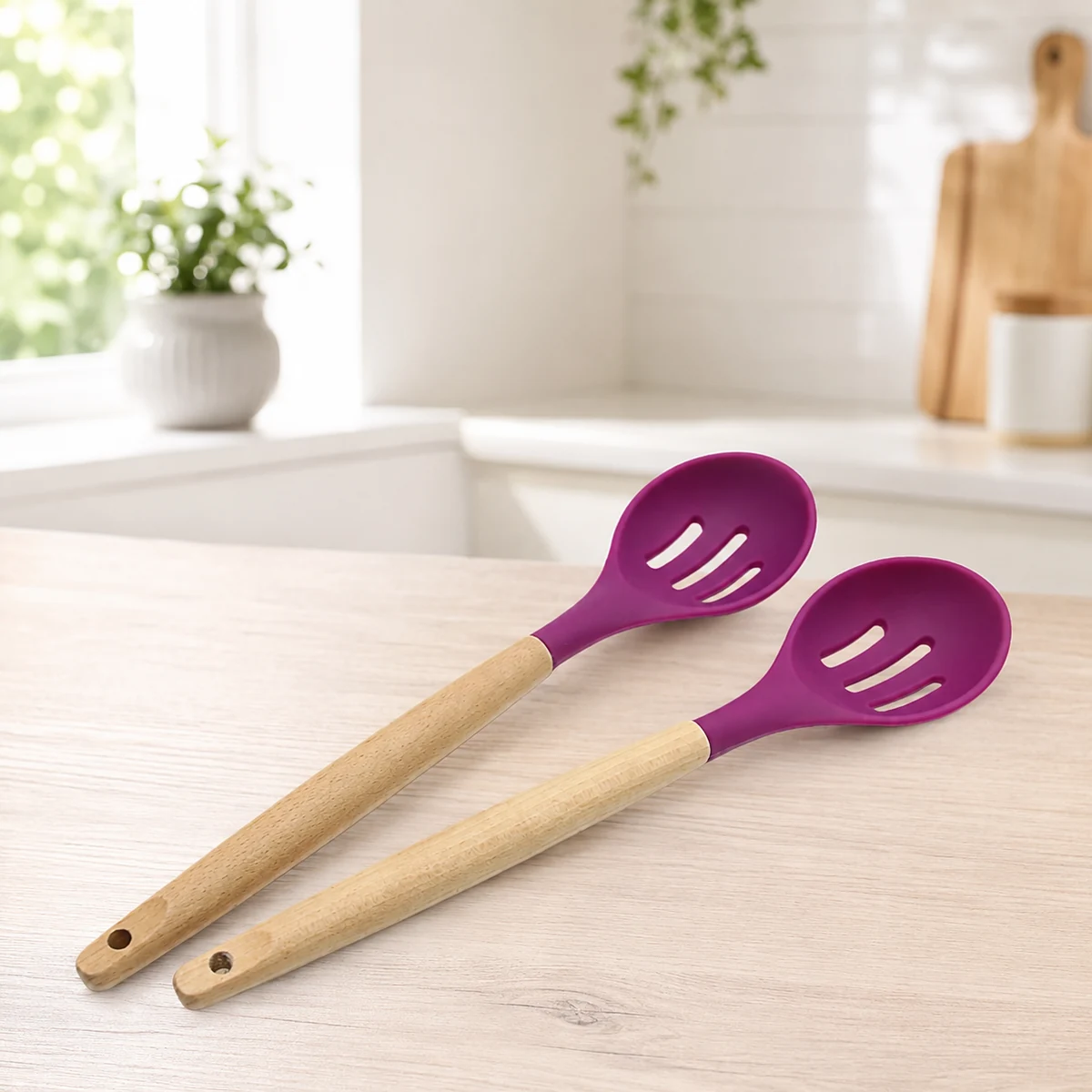
Many global buyers source from a kitchenware factory China because China has mature supply chains for silicone, glass, wood, stainless steel, packaging, printing, and mixed-material products.
The advantage is not only cost. A capable factory can help buyers coordinate product development, sample revision, decoration, packaging, inspection, and export packing.
However, buyers should still evaluate carefully.
H3: Questions to Ask a Kitchenware Factory China
- Which kitchenware categories do you produce most often?
- Do you support OEM and ODM development?
- Which materials can you work with?
- Can you provide samples before bulk production?
- What logo methods are available?
- Can you develop private label packaging?
- How do you control color consistency?
- How do you inspect product function?
- What food-contact documents can be provided if required?
- What affects MOQ and lead time?
- How do you manage mixed-SKU orders?
- Can you retain golden samples for repeat orders?
A reliable kitchenware factory China should be able to discuss risks, not only confirm that everything is possible.
Quality Control for Kitchenware Manufacturing
Quality control should cover material, appearance, function, packaging, and labeling.
| Inspection Area | What to Check |
| Material | Matches approved specification and sample |
| Appearance | No obvious scratches, stains, cracks, bubbles, or deformation |
| Color | Matches approved color reference |
| Size | Correct dimensions, weight, capacity, or thickness |
| Function | Product works as intended in real use |
| Edges and surface | Smooth, safe, and comfortable to touch |
| Logo | Correct size, position, color, and clarity |
| Assembly | Handles, inserts, lids, magnets, or parts are secure |
| Packaging | Product is protected and retail presentation is correct |
| Labels | Barcode, SKU, warning label, and carton mark are correct |
| Final standard | Compared with approved golden sample |
For kitchenware, functional testing matters. A spoon should not bend too easily. A trivet should remain stable. A glass cup should stand flat. A gift set should not move too much inside the box.
Food-Contact and Compliance Considerations
Kitchenware may come into contact with food or drinks. Buyers should confirm food-contact requirements according to the destination market and product material.
Common documents may include:
- Material declaration
- Food-contact test report
- Heavy metal or migration test where required
- Packaging material information
- Product specification sheet
- Supplier compliance declaration
- Retailer-specific test requirements
Different markets and retailers may request different documents. A factory should not guess. Buyers should confirm requirements with their importer, testing lab, or retailer before mass production.
This is especially important for silicone utensils, glass drinkware, food storage items, coatings, printing inks, adhesives, and any surface that may contact food.
Cost Factors in Custom and Wholesale Kitchenware
Kitchenware price depends on more than raw material.
| Cost Factor | Why It Affects Price |
| Material | Silicone grade, glass thickness, wood type, metal finish |
| Product size | Larger or heavier items use more material and affect shipping |
| Mold or tooling | Custom shapes require development cost |
| Logo method | Printing, engraving, embossing, or label application |
| Color quantity | Multiple colors increase production complexity |
| Packaging | Gift boxes, inserts, labels, and display boxes add cost |
| Manual work | Hand assembly, polishing, painting, or packing increases labor |
| Quality standard | More inspection steps may increase cost but reduce risk |
| Order quantity | Larger orders usually improve unit cost |
| Delivery schedule | Urgent orders may increase production or freight pressure |
Buyers should compare quotations based on the same specification. A lower price may simply exclude packaging, testing, inspection, or stronger material.
MOQ and Lead Time for Kitchenware Projects
MOQ depends on whether the product is existing, customized, or fully developed from a new mold.
A simple logo on an existing product may support a lower MOQ. A new mold, special material, custom color, custom gift box, or multi-SKU set usually requires a higher MOQ.
Lead time may include:
- Product review
- Quotation
- Sample development
- Sample revision
- Packaging proof
- Golden sample approval
- Bulk production
- Quality inspection
- Export packing
- Shipping
Buyers should plan the full project timeline, not only the bulk production time.
Common Kitchenware Sourcing Risks
| Risk | Common Cause | Recommended Control |
| Material mismatch | Material not confirmed before sampling | Approve material and physical sample |
| Weak function | Product looks good but does not work well | Test real-use performance |
| Logo defect | Wrong artwork or unsuitable logo method | Approve physical logo sample |
| Packaging damage | Packaging developed too late | Test packaging with final product |
| Color inconsistency | No color standard | Retain golden sample and color reference |
| MOQ misunderstanding | Custom requirements unclear | Confirm specifications before quotation |
| Late delivery | Sampling and revision time ignored | Build full project timeline |
| Compliance issue | Target market requirements not checked | Confirm documents before production |
| Mixed-SKU error | Weak packing control | Use barcode and packing checklist |
A good supplier will help buyers identify these risks early.
How to Work with a Custom Kitchenware OEM Partner
To make the project smoother, buyers should follow a structured process.
H3: Step 1 — Send a Clear Product Brief
Include reference photos, size, material, color, logo, quantity, packaging, target market, and delivery date.
H3: Step 2 — Ask for Feasibility Feedback
A serious supplier should comment on material, mold, function, packaging, MOQ, and possible risks.
H3: Step 3 — Approve a Physical Sample
Do not rely only on digital images. Check the actual material, color, weight, touch, logo, function, and packaging.
H3: Step 4 — Confirm a Golden Sample
The golden sample should include final product, final color, final logo, and final packaging.
H3: Step 5 — Inspect Before Shipment
Check appearance, quantity, packaging, labeling, carton marks, and product function before goods leave the factory.
Frequently Asked Questions About Kitchenware Manufacturers
What Does a Kitchenware Manufacturer Do?
A kitchenware manufacturer produces kitchen-related products such as utensils, drinkware, trays, trivets, storage items, gift sets, and private-label kitchen accessories.
What Is the Difference Between a Kitchenware Manufacturer and a Kitchenware Supplier?
A kitchenware manufacturer usually controls production more directly, while a kitchenware supplier may source products from different factories. For custom OEM projects, direct manufacturing capability is usually more important.
What Is Custom Kitchenware OEM?
Custom kitchenware OEM means producing kitchenware according to the buyer’s design, material, size, logo, color, packaging, or technical requirements.
What Products Can Be Made Through Custom Kitchenware OEM?
Common products include silicone utensils, wooden kitchen tools, glass drinkware, kitchen trivets, trays, storage items, kitchen décor, and gift sets.
How Do I Choose a Wholesale Kitchenware Supplier?
Check product category, material options, MOQ, lead time, sample quality, packaging, inspection process, and repeat-order capability.
What Is a Private Label Kitchenware Supplier?
A private label kitchenware supplier helps buyers produce kitchenware under their own brand, including custom logo, colors, packaging, barcodes, labels, and retail-ready presentation.
Why Source from a Kitchenware Factory China?
A kitchenware factory China can often provide material sourcing, custom production, packaging, sample development, and export packing support across many kitchenware categories.
What Affects Kitchenware MOQ?
MOQ depends on material, mold, color, logo method, packaging, SKU quantity, manual process, and whether the product is existing or fully customized.
How Long Does Kitchenware Sampling Take?
Sampling time depends on product complexity, material availability, mold requirements, logo method, packaging proofing, and revision rounds.
What Packaging Is Suitable for Kitchenware?
Common options include OPP bags, kraft boxes, color boxes, window boxes, gift boxes, hang tags, display boxes, and export cartons.
What Quality Checks Are Important for Kitchenware?
Important checks include material, appearance, color, size, function, logo, assembly, packaging, label, carton mark, and golden-sample comparison.
What Information Should Buyers Provide for a Quotation?
Buyers should provide product reference, size, material, quantity, logo artwork, packaging requirement, target market, quality requirements, and delivery date.
Conclusion: Choose a Kitchenware Manufacturer That Can Support More Than Production
A good kitchenware manufacturer should help buyers make better sourcing decisions before the order begins.
For B2B buyers, the best supplier is not always the one with the lowest price. It is the supplier that can review material, function, logo method, packaging, MOQ, lead time, quality control, and export requirements clearly.
Whether you need a kitchenware supplier for wholesale kitchenware, a custom kitchenware OEM partner, a kitchenware factory China for scalable production, or a private label kitchenware supplier for branded retail collections, the key is to confirm the full project details early.
HoeGifts supports global buyers with kitchenware gift development, OEM/ODM customization, material review, packaging solutions, sample production, quality inspection, and scalable manufacturing.
Contact HoeGifts with your kitchenware product idea, material preference, quantity, logo artwork, packaging requirements, target market, and delivery schedule to receive a feasibility review and quotation.