

Glass cups look simple when displayed on a retail shelf, café counter, or dining table.
But behind every finished glass cup is a complete manufacturing system involving raw material selection, forming technique, annealing, finishing, decoration, packaging, inspection, and production planning.
For retailers, importers, hospitality suppliers, drinkware brands, and private-label buyers, understanding the Glass Cup Manufacturing Process is important before placing a bulk order. The process affects product clarity, durability, heat resistance, capacity accuracy, logo quality, breakage rate, MOQ, lead time, and final customer experience.
This guide explains how glass cups are made, how to compare different types of glass materials for drinkware, when to choose handmade or machine-made production, how custom glassware production works, and what quality-control points buyers should confirm before mass production.
Why the Glass Cup Manufacturing Process Matters
The Glass Cup Manufacturing Process directly determines whether a glass cup can perform well in real use.
A cup may look attractive in a catalog photo, but buyers still need to confirm whether it has:
- Correct material for hot or cold beverages
- Stable wall thickness
- Smooth drinking rim
- Accurate capacity
- Strong base stability
- Safe surface finish
- Durable logo decoration
- Export-safe packaging
- Consistent quality across bulk production
For B2B buyers, the goal is not only to receive a beautiful sample. The real goal is to make sure the approved sample can be repeated consistently across hundreds, thousands, or tens of thousands of units.
This is why production process knowledge helps buyers reduce sourcing risk.
Overview of the Glass Cup Manufacturing Process
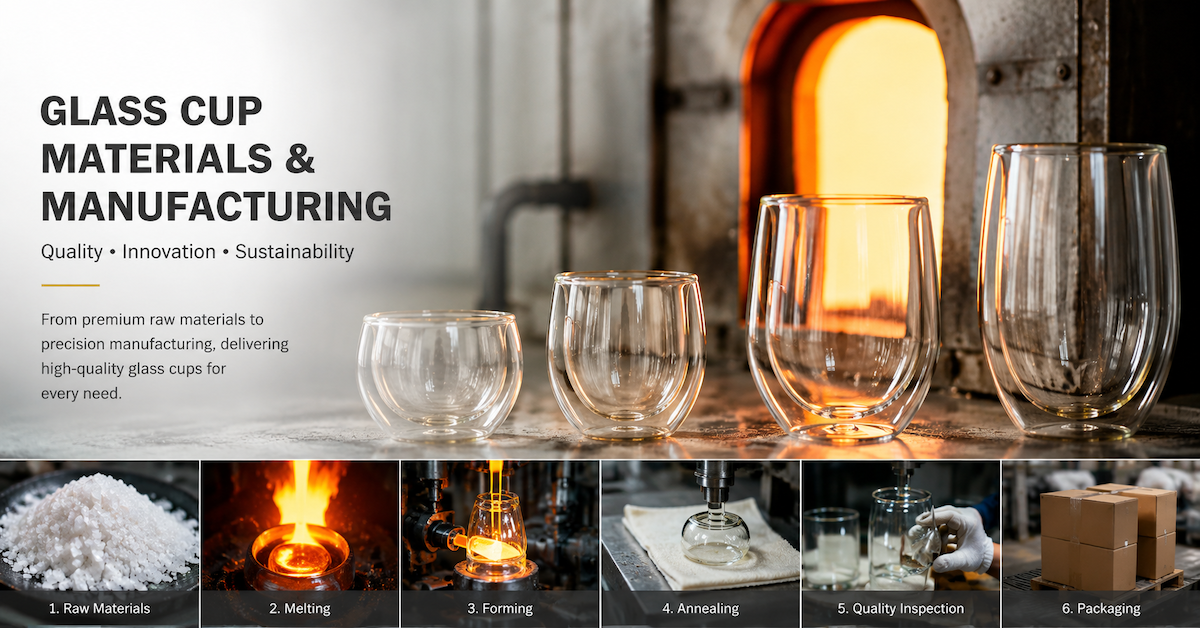
A typical glass cup project follows several production stages.
| Stage | Main Purpose | Buyer Concern |
|---|---|---|
| Raw material preparation | Select and mix glass ingredients | Material quality, clarity, heat resistance |
| Melting | Turn raw materials into molten glass | Impurity control and color consistency |
| Forming | Shape the glass into cups | Capacity, thickness, shape, and balance |
| Annealing | Reduce internal stress | Durability and breakage prevention |
| Finishing | Smooth rim and surface | User safety and appearance |
| Decoration | Add logo, color, coating, or pattern | Brand accuracy and durability |
| Inspection | Check quality before packing | Defect control and consistency |
| Packaging | Protect goods during shipping | Breakage rate and retail presentation |
Each step affects the next one. A forming problem cannot always be fixed during finishing. Weak packaging can ruin an otherwise well-made product. Poor annealing may not be visible immediately, but it can cause breakage later.
A reliable glass cup manufacturer should control the whole workflow rather than treating each stage separately.
Raw Material Preparation
Glass cup production usually begins with selected raw materials such as:
- Silica sand
- Soda ash
- Limestone
- Borates for borosilicate glass
- Colorants where needed
- Recycled glass cullet where suitable
The material formula affects clarity, melting behavior, strength, thermal performance, weight, and production cost.
For B2B buyers, material selection should be confirmed before sampling. Changing the glass material after sample approval may affect the unit price, MOQ, lead time, testing requirements, and final appearance.
Melting and Refining
After batching, the raw materials are melted in a furnace at very high temperatures.
During melting and refining, the factory must control:
- Temperature stability
- Impurity removal
- Bubble reduction
- Color consistency
- Molten glass flow
- Production efficiency
Poor melting control can result in cloudy glass, visible bubbles, uneven color, inclusions, or unstable product strength.
For clear drinkware, optical clarity is especially important because consumers can easily notice defects when the cup is empty or filled with beverages.
Forming the Glass Cup
Forming is the stage where molten glass becomes the cup shape.
Common forming methods include:
- Blowing
- Pressing
- Molding
- Machine-assisted forming
- Handmade forming
During forming, the manufacturer controls:
- Cup height
- Diameter
- Capacity
- Wall thickness
- Rim shape
- Base thickness
- Handle position if applicable
- Product weight
- Mold detail
- Overall balance
For drinkware, capacity accuracy is a key commercial requirement. A cup advertised as 350 ml, 450 ml, or 500 ml should match the approved specification within an agreed tolerance.
If the cup includes a handle, straw hole, lid, or sleeve, these elements should be reviewed together during sample development.
Annealing and Stress Control
Annealing is one of the most important steps in the Glass Cup Manufacturing Process.
After forming, glass must be cooled gradually under controlled conditions. This reduces internal stress and improves durability.
If annealing is not properly controlled, glass cups may crack during:
- Decoration
- Packaging
- Transportation
- Temperature changes
- Customer use
- Dishwasher or washing cycles
Annealing is especially important for thick-base cups, handled mugs, molded glass, and borosilicate glass products.
A buyer may not be able to judge annealing quality from photos alone, so supplier process control and inspection procedures matter.
Finishing and Decoration
After annealing, the glass cup may go through finishing and decoration.
Common finishing processes include:
- Rim polishing
- Surface cleaning
- Edge smoothing
- Base finishing
- Final polishing
Common decoration methods include:
- Logo printing
- Laser engraving
- Decal decoration
- Frosted finish
- Color spraying
- Metallic detail
- Pattern printing
- Private-label packaging
The decoration method should match the product’s actual use.
For example, a glass cup used daily in cafés or restaurants may need more durable logo treatment than a promotional gift cup used occasionally. A premium gift cup may need more refined packaging and surface presentation.
Types of Glass Materials for Drinkware
Choosing the right material is one of the most important decisions in glassware production.
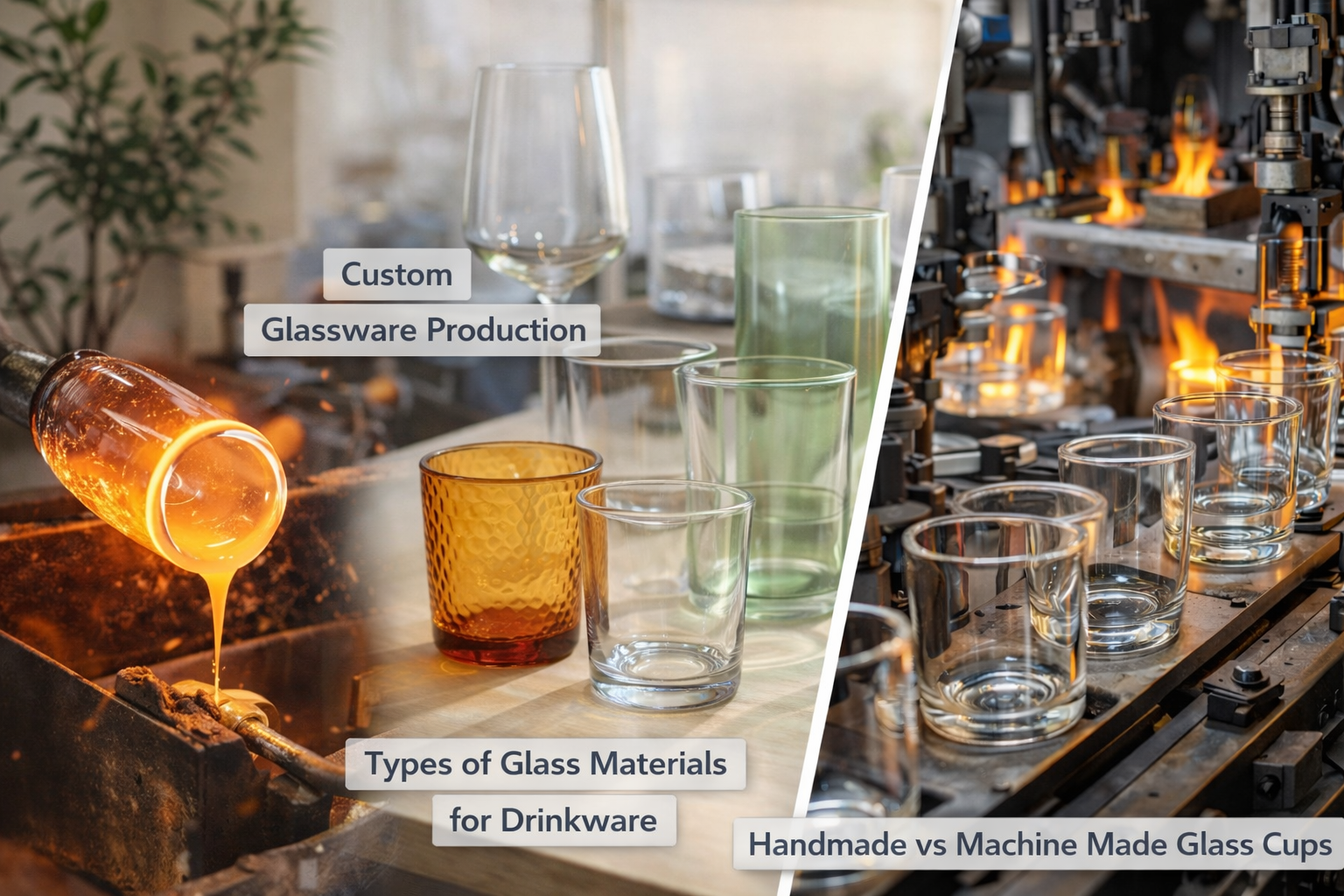
Different Types of Glass Materials for Drinkware offer different benefits in cost, clarity, durability, heat resistance, weight, and perceived value.
| Glass Material | Main Advantage | Main Limitation | Suitable Use |
| Soda-lime glass | Cost-effective and widely available | Moderate thermal shock resistance | Everyday cups, beer mugs, retail drinkware |
| Borosilicate glass | Better heat resistance and lightweight feel | Higher production cost | Tea cups, coffee cups, double-wall cups |
| Lead-free crystal glass | High clarity and premium appearance | Higher cost and more careful handling | Giftware, barware, premium drinkware |
| Colored glass | Strong visual effect | Color consistency must be controlled | Lifestyle cups and decorative drinkware |
| Recycled-content glass | Supports sustainability positioning | Appearance depends on process control | Eco-focused product programs |
The right material should be selected according to beverage use, target market, retail price, packaging plan, and quality expectations.
Soda-Lime Glass for Everyday Drinkware
Soda-lime glass is the most widely used glass material for daily drinkware.
It is commonly used for:
- Water glasses
- Juice cups
- Beer mugs
- Tumblers
- Retail glassware sets
- Hospitality drinkware
- Promotional cups
Its biggest advantage is cost efficiency. It supports large-volume production and is suitable for many standard drinkware programs.
However, soda-lime glass has moderate thermal shock resistance. If buyers want to use the cup for hot drinks or rapid temperature changes, they should review the product design and use requirements carefully.
Borosilicate Glass for Heat Resistance
Borosilicate glass is often selected for premium drinkware because it offers better resistance to temperature changes.
It is commonly used for:
- Tea cups
- Coffee cups
- Double-wall cups
- Lightweight drinkware
- Premium glassware
- Lifestyle gift collections
Compared with soda-lime glass, borosilicate glass usually feels lighter and more refined. It is suitable for products positioned around modern design, hot beverage use, and higher perceived value.
The main limitation is cost. Borosilicate glass generally requires a higher budget and more specific production planning.
Handmade vs Machine Made Glass Cups
Buyers should also understand the difference between Handmade vs Machine Made Glass Cups.
Both methods have value, but they serve different market needs.
Handmade Glass Cups
Handmade glass cups are often chosen for artistic or premium collections.
They may offer:
- Unique shapes
- More handcrafted character
- Higher perceived value
- Better storytelling
- Smaller-batch product appeal
Handmade production is suitable for premium giftware, boutique retail, artisan-style drinkware, and special collections.
However, handmade products may show slight variation in size, shape, thickness, or finish. Buyers should define acceptable variation before bulk production.
Machine Made Glass Cups
Machine-made glass cups are suitable for large-volume orders and repeatable retail programs.
They offer:
- Better consistency
- Higher production efficiency
- Lower unit cost
- Stable capacity control
- Easier repeat orders
- Better scalability
Machine-made production is suitable for supermarkets, hospitality suppliers, promotional programs, distributors, and private-label retail lines.
Comparison Table
| Factor | Handmade Glass Cups | Machine Made Glass Cups |
| Appearance | More artistic and individual | More uniform and consistent |
| Cost | Usually higher | Usually lower |
| Production volume | Better for small or premium batches | Better for large orders |
| Variation | Natural variation may exist | Lower variation |
| Best for | Boutique gifts and premium collections | Retail, wholesale, and hospitality programs |
| Buyer focus | Craft character and perceived value | Consistency, cost, and scalability |
The choice should depend on brand positioning, order quantity, target price, and quality tolerance.
Glass Drinkware Manufacturing Techniques
Different Glass Drinkware Manufacturing Techniques create different product effects.
Blown Glass Technique
Blown glass is suitable for rounded forms, lightweight shapes, and more artistic designs.
It is often used for:
- Decorative cups
- Handmade-style drinkware
- Premium glassware
- Special shapes
Buyers should pay attention to wall thickness, shape consistency, and rim quality.
Pressed Glass Technique
Pressed glass uses molds to create repeatable shapes and patterns.
It is suitable for:
- Textured glasses
- Vintage-style cups
- Bowls
- Candle holders
- Heavy-base drinkware
Pressed glass supports good repeatability, but mold quality and surface finish must be controlled.
Molded Glass Production
Molded production is useful when the buyer needs specific shapes, embossed patterns, or consistent structures.
It is suitable for:
- Custom logo shapes
- Thick-base cups
- Beer mugs
- Promotional drinkware
- Retail sets
Custom molds usually affect MOQ, tooling cost, and development time.
Cut and Polished Finishing
Cutting and polishing can improve rim quality, surface detail, and final user experience.
This is important because the drinking rim is one of the most sensitive parts of a glass cup. A poor rim finish can lead to customer complaints even if the cup body looks acceptable.
Custom Glassware Production
Custom Glassware Production allows brands to create exclusive drinkware products instead of relying only on standard catalog items.
Customization may include:
- Custom shape
- Custom capacity
- Custom thickness
- Custom color
- Logo printing
- Laser engraving
- Frosting
- Decal decoration
- Gift box packaging
- Barcode labels
- Private-label branding
- Product set development
For retailers and brand owners, customization helps improve product differentiation, brand recognition, and retail value.
Custom Glass Cup Development Workflow
A structured custom project usually follows this process:
| Stage | What Happens |
| Product brief | Buyer confirms material, size, capacity, market, and packaging |
| Feasibility review | Supplier checks structure, mold, decoration, MOQ, and risk |
| Quotation | Price is based on confirmed specifications |
| Sample development | Factory produces physical sample |
| Sample revision | Buyer reviews and requests adjustments |
| Golden sample approval | Final sample becomes production standard |
| Bulk production | Factory produces according to approved sample |
| Quality inspection | Product and packaging are checked |
| Shipment preparation | Cartons, labels, and packing details are confirmed |
A clear brief helps avoid repeated revisions and unexpected cost changes.
Buyers should prepare product references, target capacity, material preference, logo artwork, packaging needs, estimated quantity, and delivery schedule before requesting a quotation.
Quality Control in Glass Cup Manufacturing
Quality control should be built into every stage of production.
Key inspection areas include:
| Inspection Area | What to Check |
| Material | Matches approved glass type |
| Clarity | No visible cloudiness, dirt, or unwanted color issues |
| Surface | No cracks, chips, bubbles, or sharp points |
| Rim | Smooth, even, and safe for drinking |
| Capacity | Matches approved specification |
| Base | Stable and balanced |
| Decoration | Correct logo, color, pattern, and position |
| Packaging | Correct protection, labels, quantity, and carton marks |
| Final standard | Compared with approved golden sample |
For custom glassware production, logo accuracy and packaging consistency are especially important. A wrong print position, unclear logo, weak carton, or poor inner protection can make the product unsuitable for retail or promotion.
Packaging for Glass Drinkware
Packaging is critical because glass drinkware is fragile.
Common packaging options include:
- Bulk carton packing
- Individual white box
- Kraft box
- Color box
- Window box
- Gift box
- Corrugated divider
- Molded pulp insert
- Foam insert
- Export carton
Packaging should match the sales channel.
For hospitality or wholesale buyers, safe and efficient carton packing may be the priority. For gift brands and retailers, individual boxes, color boxes, or gift packaging may be more important.
Packaging should be approved with the final finished product, not only with an undecorated sample. Logo, coating, straw, lid, handle, or accessories may change how the product fits inside the box.
Sustainability and Recycled Glass Options
Sustainability is becoming more important in glassware sourcing.
Glass can support sustainable product strategies because it is reusable and recyclable when properly collected and processed.
Buyers may consider:
- Durable reusable cup design
- Recycled glass content where suitable
- Plastic-reduced packaging
- Recyclable paper packaging
- Molded pulp inserts
- Efficient carton structure
- Longer product life
- Reduced breakage through better packaging
However, sustainability should not be expressed through broad unsupported claims. Buyers should use specific descriptions such as recyclable paper packaging, reusable glass cup, molded pulp insert, or plastic-reduced packaging.
Common Sourcing Risks
| Risk | Common Cause | Recommended Control |
| Wrong material choice | Use condition not confirmed | Define hot or cold drink application early |
| Capacity mismatch | Specification not measured before approval | Check physical sample capacity |
| Rim defect | Poor finishing control | Inspect rim smoothness carefully |
| Breakage during shipping | Weak packaging structure | Test packed samples |
| Logo defect | Artwork or decoration method not confirmed | Approve physical logo sample |
| Color inconsistency | No physical standard | Retain golden sample |
| Handmade variation too large | Tolerance not defined | Confirm acceptable variation before production |
| Late delivery | Sampling and packaging time omitted | Plan full project timeline |
A reliable supplier should help buyers identify these risks before production begins.
How to Choose a Glass Cup Manufacturer
Before choosing a supplier, buyers should ask:
- What glass materials are available?
- What glass cup manufacturing process is used?
- Can the supplier explain handmade vs machine made glass cups?
- Which glass drinkware manufacturing techniques are available?
- Can the supplier support custom glassware production?
- What logo and decoration methods are available?
- Can samples be made before bulk production?
- How is capacity checked?
- How is rim quality inspected?
- What packaging options are available?
- Can the supplier support repeat orders?
- What affects MOQ and lead time?
A strong manufacturer should provide practical technical feedback, not only product photos and pricing.
Frequently Asked Questions
What Is the Glass Cup Manufacturing Process?
The Glass Cup Manufacturing Process includes raw material preparation, melting, forming, annealing, finishing, decoration, inspection, and packaging.
What Are the Main Types of Glass Materials for Drinkware?
Common types include soda-lime glass, borosilicate glass, lead-free crystal glass, colored glass, and recycled-content glass where suitable.
What Is Custom Glassware Production?
Custom Glassware Production means developing glassware according to buyer requirements, including shape, size, capacity, logo, color, decoration, packaging, and private-label branding.
What Is the Difference Between Handmade and Machine Made Glass Cups?
Handmade glass cups offer artistic character and higher perceived value, while machine-made glass cups offer better consistency, lower cost, and stronger scalability.
Which Glass Drinkware Manufacturing Technique Is Best?
The best technique depends on the product. Blown glass is suitable for artistic forms, pressed glass is suitable for repeatable patterns, and molded glass is suitable for custom structures and larger production runs.
Can Glass Cups Be Customized with Logos?
Yes. Common methods include screen printing, laser engraving, decals, frosting, UV printing, and custom packaging.
What Should Buyers Confirm Before Sampling?
Buyers should confirm material, capacity, shape, dimensions, logo method, packaging, quantity, target market, and delivery schedule.
How Can Buyers Reduce Breakage Risk?
Buyers can reduce breakage risk by choosing suitable packaging, approving packed samples, using inserts or dividers, and confirming carton strength.
Conclusion
Understanding the Glass Cup Manufacturing Process helps B2B buyers make better sourcing decisions.
From raw material selection and forming method to handmade versus machine-made production, each decision affects product quality, cost, durability, packaging, and market positioning.
The right glass material improves performance. The right production technique improves consistency. Custom glassware production helps brands create differentiated products. Strong quality control protects buyer expectations and reduces after-sales risk.
As a glassware and gift product manufacturer, HoeGifts supports global buyers with material review, glass cup development, custom glassware production, logo decoration, packaging solutions, quality inspection, and scalable manufacturing.
Contact HoeGifts with your glass cup design, material preference, capacity, quantity, logo artwork, packaging requirements, and delivery schedule to receive a feasibility review and quotation.