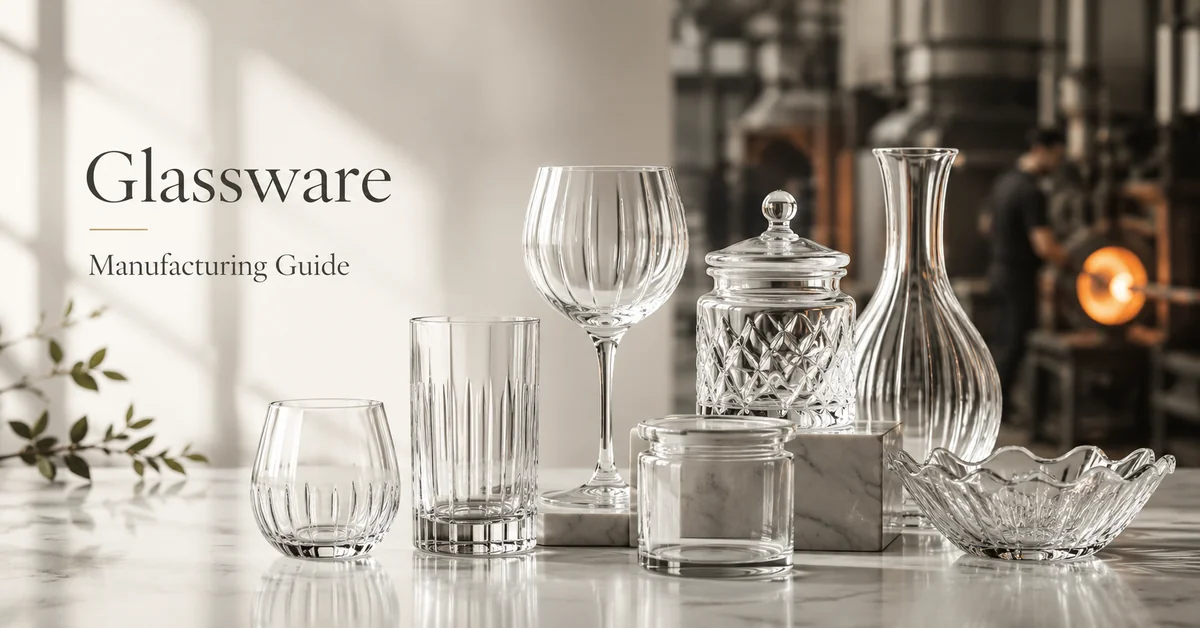

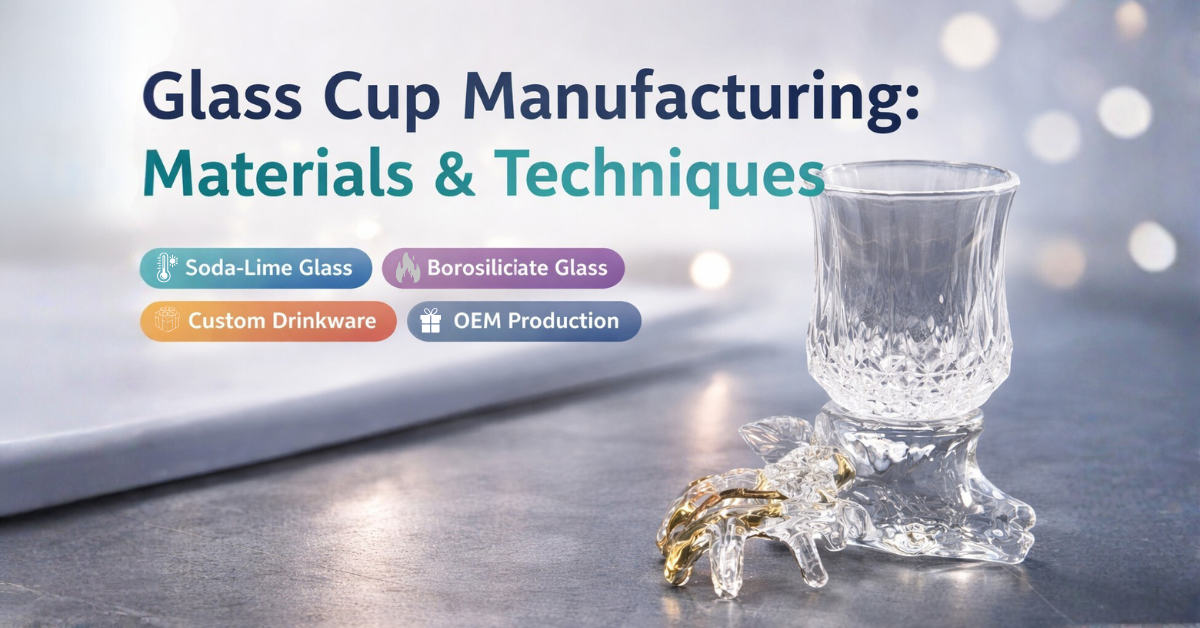

A glass cup may look like one of the simplest products in a homeware collection. In practice, developing a reliable glass cup involves a long list of connected decisions.
Material composition affects heat resistance and weight. Forming methods influence wall thickness and shape. Rim design changes drinking comfort. Decoration methods affect dishwasher performance. Packaging determines whether the product survives export shipping. Even a small decision—such as adding a metallic rim or making the wall slightly thinner—can alter cost, lead time, testing requirements, and breakage risk.
For brands, importers, retailers, hospitality buyers, and OEM/ODM product developers, successful glass cup product development is therefore not only a design exercise. It is a balance between appearance, functionality, manufacturability, quality consistency, and total landed cost.
This guide explains the main glass materials, manufacturing techniques, decoration options, quality risks, and supplier evaluation points that B2B buyers should understand before launching a custom drinkware project.
Glass Cup Development Overview: Materials and Manufacturing Guide
Glass cup development usually begins with choosing among soda-lime glass, borosilicate glass, and lead-free crystal glass. Soda-lime glass is widely used for cost-effective everyday drinkware. Borosilicate glass is commonly selected for lighter, heat-resistant, and double-wall designs. Lead-free crystal is used when brilliance, weight, and premium presentation are important.
The correct manufacturing method depends on the cup shape, wall thickness, order volume, decoration, and target price. Buyers should confirm the intended beverage, temperature conditions, glass composition, rim finish, capacity, packaging, compliance, MOQ, lead time, and an approved physical sample before mass production.
- Material must match the actual beverage and usage conditions.
- A thinner glass cup is not automatically higher quality.
- Machine production offers consistency; hand production offers character and flexibility.
- Decoration should be tested for adhesion, abrasion, and dishwasher use where required.
- Packaging must be developed together with the product, not after production.
- Actual cup capacity, rim quality, stability, and thermal performance should be verified.
- A retained golden sample is essential for repeat orders.
- Supplier selection should consider engineering and quality control, not only price.
Why Glass Cups Remain a Strong Product Category
Glass cups serve almost every level of the beverage market.
They are used in:
- Homeware and kitchen collections
- Cafes and beverage shops
- Hotels and restaurants
- Corporate gifting
- Wedding and seasonal gifts
- Supermarket drinkware programs
- E-commerce and private-label brands
- Premium barware collections
The category also supports a wide range of styles. A basic clear tumbler can target everyday retail. A colored pressed cup may fit a vintage collection. A double-wall borosilicate cup can appeal to modern coffee users. A weighted crystal tumbler can enter the premium gifting market.
This flexibility makes glass cups commercially attractive, but it also creates sourcing complexity. Two products that look similar in a catalog may behave very differently in real use.
Start with the Product Brief
Before selecting a material or production process, buyers should define what the cup is expected to do.
A useful product brief should include:
- Beverage type
- Hot or cold use
- Target capacity
- Intended user
- Retail channel
- Target price
- Preferred weight
- Shape and style
- Stacking requirement
- Lid or straw compatibility
- Decoration method
- Packaging format
- Destination market
- Estimated order quantity
This information helps the manufacturer recommend a suitable structure.
For example, a 500 ml iced coffee tumbler with a straw has different requirements from a 90 ml espresso cup. A hospitality glass may need stacking efficiency and replacement continuity, while a gift cup may prioritize visual appeal and presentation packaging.
Main Glass Materials for Cup Development
Soda-Lime Glass
Soda-lime glass is the most widely used material for ordinary glass drinkware.
It is suitable for:
- Water tumblers
- Juice glasses
- Beer glasses
- Everyday cups
- Restaurant drinkware
- Retail glass sets
Its main commercial advantages are stable supply, familiar manufacturing methods, broad design availability, and cost efficiency.
Soda-lime glass can be blown, pressed, colored, decorated, or strengthened through suitable treatment. It works well for high-volume programs where consistent shape and competitive pricing are important.
However, normal soda-lime glass has limitations under rapid temperature change. Buyers should not assume that every soda-lime glass cup is suitable for boiling water, freezer-to-hot-water use, or sudden thermal shock.
Borosilicate Glass
Borosilicate glass has a lower coefficient of thermal expansion than ordinary soda-lime glass. This makes it useful for products exposed to wider temperature changes.
Common applications include:
- Hot beverage cups
- Tea glasses
- Coffee cups
- Double-wall tumblers
- Lightweight drinkware
- Cups with glass straws and lids
Borosilicate cups are often thinner and lighter than pressed soda-lime products. Their clean appearance works well in minimalist and premium lifestyle collections.
Still, borosilicate glass is not unbreakable. Thin walls may resist thermal change but remain vulnerable to impact. Buyers should evaluate both thermal performance and mechanical handling.
Lead-Free Crystal Glass
Lead-free crystal glass is selected when brilliance, clarity, acoustic quality, and premium presentation matter.
It is often used for:
- Whiskey tumblers
- Wine glasses
- Cocktail glasses
- Gift sets
- Barware
- Commemorative collections
The term “lead-free crystal” can cover different formulations. Buyers should request material information instead of relying only on a product name.
Crystal-style glass products may feel heavier or more refined, but their suitability depends on the design, target market, decoration, and compliance requirements.
Material Comparison for B2B Buyers
| Material | Main Strength | Main Limitation | Best Use |
|---|---|---|---|
| Soda-lime glass | Cost-effective and scalable | Moderate thermal-shock resistance | Everyday and mass-retail drinkware |
| Borosilicate glass | Better thermal performance and light weight | Higher cost and impact sensitivity | Hot drinks and double-wall cups |
| Lead-free crystal | Brilliance and premium perception | Higher price and delicate handling | Barware and gifting |
| Strengthened glass | Improved mechanical durability where applicable | Process limitations by shape | Hospitality and frequent-use cups |
| Recycled-content glass | Potential reduction in virgin input | Color and consistency may vary | Sustainability-focused collections |
Material choice should be based on the actual specification. A supplier should be able to explain the glass type, intended use, and relevant limitations.
How Glass Cups Are Manufactured
Machine-Blown Glass
Machine blowing is widely used for hollow glass drinkware.
Molten glass is formed inside molds using controlled air pressure and production machinery. The process supports repeatable dimensions, relatively consistent wall thickness, and high production output.
Machine-blown glass is suitable for:
- Retail collections
- Hospitality programs
- Long-term product lines
- Standardized cups and stemware
- High-volume private-label orders
Its efficiency depends on mold design, glass distribution, forming speed, cooling, and production setup.
Buyers should understand that a machine-blown product still has acceptable manufacturing tolerances. Minor differences in weight, wall distribution, and mold marks may occur within agreed limits.
Hand-Blown Glass
Hand-blown glass is shaped by skilled workers using blowing and forming tools.
It is suitable for:
- Artistic cups
- Limited collections
- Organic shapes
- Decorative glassware
- Premium handmade lines
Hand production offers visual character and flexibility, but natural variation is part of the process.
Buyers should define acceptable variation in height, diameter, weight, color, bubbles, and shape. A handcrafted product should not be judged by the same tolerance as a fully automated product, but “handmade” should also not be used to excuse structural defects.
Pressed Glass
Pressed glass is made by placing molten glass into a mold and pressing it into shape with a plunger.
It works well for:
- Thick tumblers
- Textured cups
- Vintage designs
- Embossed patterns
- Heavy-base drinkware
- Hospitality products
Pressed glass can reproduce detailed surface patterns and create a substantial feel.
The process may produce visible mold seams or changes in wall thickness, depending on the design. These should be reviewed during sampling rather than discovered after production.
Double-Wall Glass Production
Double-wall cups normally consist of an inner and outer glass wall joined into one structure.
They provide:
- Thermal insulation
- Reduced external heat
- Reduced condensation for cold drinks
- A floating beverage appearance
- Lightweight modern styling
The sealed area and joining quality require careful inspection. Common risks include water entering the cavity, visible sealing marks, uneven spacing, or failure during temperature changes.
Manufacturing Method Comparison
| Method | Consistency | Design Flexibility | Volume Suitability | Typical Market |
| Machine blown | High | Medium | High | Retail and hospitality |
| Hand blown | Medium | High | Low to medium | Premium and artistic |
| Pressed glass | High | Medium | High | Textured and durable collections |
| Double-wall forming | Medium to high | Medium | Medium to high | Coffee and lifestyle drinkware |
| Cut and polished glass | High for simple geometry | Limited | Medium | Specialty and decorative forms |
The best method is the one that delivers the desired appearance at the required quantity and price while maintaining stable quality.
Design-for-Manufacturing Considerations
Rim Design
The rim directly affects drinking comfort and safety.
Buyers should check:
- Smoothness
- Roundness
- Thickness
- Chips
- Sharp edges
- Decoration near the drinking area
A visually delicate rim may look premium, but it must remain strong enough for intended handling.
Wall Thickness
Wall thickness affects weight, strength, heat behavior, cooling speed, and user perception.
Very thick walls increase weight and material consumption. Very thin walls may feel refined but require tighter production and packaging control.
The correct thickness depends on material, shape, capacity, process, and use.
Base Stability
The base should remain flat and stable on a tabletop.
Check:
- Rocking
- Uneven bottom surfaces
- Excessive base thickness
- Internal stress
- Decorative features that affect balance
Tall cups and narrow bases require extra attention to tipping risk.
Capacity
Buyers should clarify whether capacity means:
- Full-to-rim capacity
- Recommended drinking capacity
- Nominal retail capacity
Confusion between these definitions can cause specification disputes.
Stackability
Stackable cups save storage space in restaurants and warehouses, but poor stacking design can cause cups to jam, scratch, or chip.
A stacking test should use several finished cups, not only a 3D drawing.
Surface Decoration and Product Differentiation
Screen Printing
Screen printing is commonly used for logos, simple graphics, and repeated decorative patterns.
Its success depends on:
- Ink compatibility
- Surface preparation
- Curing
- Print thickness
- Dishwasher requirement
- Artwork complexity
Decals
Decals support detailed, multicolor artwork and wraparound designs.
After application, they may be fired or otherwise fixed depending on the system. Buyers should inspect color consistency, edge visibility, placement, and durability.
Frosting
Frosted surfaces can be created through chemical treatment, blasting, or coating methods.
They provide a soft appearance and can improve grip, but may show oil marks or cleaning variation depending on the finish.
Spray Coloring
Spray coatings allow gradient colors, translucent effects, and broad SKU expansion.
The coating should be tested for adhesion, abrasion, washing, and contact with lids or packaging.
Metallic Rims
Gold-tone, silver-tone, or other metallic rims create a premium appearance.
They may limit dishwasher suitability and require careful handling. Buyers should confirm the correct consumer instructions and durability expectations.
Engraving and Etching
Logos or patterns can be engraved, etched, or sandblasted into the glass.
These methods offer a subtle and long-lasting appearance, though fine details and production speed depend on the process.
Decoration Comparison
| Decoration | Visual Effect | Durability Consideration | Suitable For |
| Screen printing | Clean logos and patterns | Ink adhesion and curing | Branded retail cups |
| Decal | Detailed multicolor artwork | Edge and firing quality | Gift and seasonal collections |
| Frosting | Soft, premium surface | Cleaning and fingerprint visibility | Lifestyle drinkware |
| Spray color | Gradient and transparent effects | Scratch and wash resistance | Trend-driven collections |
| Metallic rim | Luxury appearance | Often requires careful washing | Gift sets and premium cups |
| Engraving | Subtle permanent marking | Limited color | Corporate and personalized gifts |
Quality Control for Glass Cups
A complete inspection should cover more than visible appearance.
| Inspection Item | What to Check |
| Material | Correct glass type and approved composition |
| Dimensions | Height, diameter, rim, base, and capacity |
| Weight | Within agreed tolerance |
| Rim | Smooth, even, chip-free |
| Body | Bubbles, stones, scratches, distortion |
| Base | Flatness, stability, stress marks |
| Decoration | Position, color, adhesion, completeness |
| Function | Lid, straw, handle, stacking, or saucer fit |
| Thermal performance | Test according to intended use |
| Packaging | Protection, quantity, labels, and carton strength |
Some small bubbles or mold marks may be normal depending on the manufacturing process. Buyers and suppliers should agree on acceptable defect standards before production.
Thermal and Mechanical Testing
A cup intended for cold beverages does not require the same testing as a hot-tea cup.
Possible evaluations include:
- Thermal shock test
- Hot-water use test
- Dishwasher test
- Impact or drop assessment
- Rim strength
- Handle pull test
- Base stability
- Decoration adhesion
- Leakage test for double-wall designs
The test method should match actual use. An unrealistic test can either reject a suitable product or create a false sense of safety.
Food-Contact and Market Compliance
Glass cup compliance depends on the destination market, decoration, and intended use.
Buyers may need to review:
- Glass composition
- Heavy metal migration from decorations
- Paints and decals
- Metallic rim materials
- Food-contact requirements
- Retailer restricted-substance lists
- Warning and care labels
- Packaging documentation
The undecorated glass body and the finished decorated cup should not be treated as identical products for compliance purposes.
A general report for clear glass may not cover a newly added colored coating or decal.
Packaging Development for Export
Glassware packaging has two jobs: protect the product and support efficient shipping.
Common options include:
- Paper wrap
- Bubble bag
- Corrugated partitions
- Molded pulp
- Foam inserts
- Individual white boxes
- Printed color boxes
- Gift boxes
- Master cartons
- Pallets
Packaging requirements depend on the sales channel.
A supermarket set may prioritize carton efficiency. A corporate gift may need premium presentation. An e-commerce cup needs protection through parcel handling.
Buyers should request:
- Individual packing method
- Pieces per carton
- Carton dimensions
- Net and gross weight
- Packing photos
- Barcode position
- Drop-test or shipping-test plan where required
Packaging should be approved with the final decorated product. A coating that looks durable at the factory may scratch when it rubs against an insert during transport.
OEM and ODM Development Process
A practical custom glass cup project normally follows these steps:
- Product brief
Buyer provides capacity, use, material preference, references, quantity, market, and target price. - Feasibility review
Supplier evaluates shape, process, mold, thickness, decoration, packaging, and risks. - Drawing and quotation
Dimensions, weight, tooling, decoration, unit price, and packaging assumptions are confirmed. - Mold or prototype development
A mold, handmade prototype, or available sample is prepared. - Sample evaluation
Buyer checks shape, weight, rim, capacity, use, decoration, and packaging. - Golden sample approval
The approved sample becomes the bulk production standard. - Mass production
Factory controls material, forming, annealing, decoration, and assembly. - Inspection and packing
Finished products are inspected and packed according to the agreed method. - Shipment and repeat-order control
Drawings, artwork, color standards, and samples are retained.
MOQ, Tooling, and Lead-Time Factors
MOQ depends on:
- Existing or custom mold
- Glass material
- Production method
- Capacity
- Number of colors
- Decoration
- Lid or straw accessories
- Packaging
- Number of SKUs
- Furnace and production scheduling
Using an existing cup shape with custom printing may allow a lower development threshold. A new pressed mold, custom color, or unusual shape usually requires a larger commitment.
Lead time should include:
- Design confirmation
- Mold production
- Mold testing
- Glass sample
- Decoration sample
- Packaging proof
- Revisions
- Production
- Inspection
- Shipping
Buyers should ask for each stage separately.
What Affects the Price of a Custom Glass Cup?
The main cost factors include:
- Glass type
- Product weight
- Shape complexity
- Tooling
- Production volume
- Number of colors
- Decoration method
- Manual work
- Accessories
- Testing
- Packaging
- Shipping weight
- Breakage allowance
A lightweight borosilicate cup may use less glass but cost more due to material, production control, and lower output. A heavy pressed cup may have a lower unit cost at high volume but increase freight costs.
The most useful comparison is total landed cost relative to expected retail price.
Sustainability in Glass Cup Development
Glass can support reusable product systems and may be recyclable where suitable collection and recycling infrastructure exists.
However, not every finished glass cup is accepted in ordinary container-glass recycling streams. Heat-resistant glass, crystal formulations, coatings, metallic decoration, and mixed-material components may require different treatment.
Credible sustainability actions include:
- Designing for long service life
- Avoiding unnecessary product weight
- Reducing rejects
- Using efficient carton loading
- Selecting recyclable paper packaging
- Avoiding excessive plastic inserts
- Separating removable silicone, metal, or bamboo parts
- Providing clear care instructions
- Avoiding unsupported “100% sustainable” claims
Durability and repeated use are often more practical sustainability benefits than broad recycling statements.
How to Evaluate a Glass Cup Manufacturer
Ask the supplier:
- Which glass materials are available?
- Which forming processes are completed in-house?
- Can the factory explain thermal limitations?
- How are molds maintained?
- How is capacity measured?
- What defects are considered acceptable?
- Can decoration durability be tested?
- How is annealing controlled?
- Can the supplier develop export packaging?
- Are golden samples retained?
- How are repeat-order colors controlled?
- Which compliance documents can be provided?
A reliable supplier should explain both the advantages and limitations of the proposed design.
Common Development Risks
| Risk | Common Cause | Prevention |
| Cup cracks in hot use | Wrong glass or thermal expectation | Define use and test conditions |
| Rim chips | Poor finishing or packaging | Inspect rim and improve protection |
| Color scratches | Weak coating | Test adhesion and abrasion |
| Capacity mismatch | Different measurement definitions | Confirm full and recommended capacity |
| Cup rocks | Uneven base | Add stability inspection |
| Decoration fades | Unsuitable ink or curing | Approve durability test |
| Double wall leaks | Weak sealing process | Perform leakage inspection |
| Breakage in transit | Packaging not validated | Test final packed product |
| Repeat-order variation | No retained standards | Keep drawings and golden samples |
| Delivery delay | Mold and approvals omitted | Build a full development schedule |
Frequently Asked Questions
1. Which glass is best for everyday cups?
Soda-lime glass is widely used because it offers a practical balance of cost, clarity, and production scale.
2. Is borosilicate glass better than soda-lime glass?
It offers better resistance to temperature change, but it is not automatically better for every product. Cost, weight, impact handling, and use should be considered.
3. What is lead-free crystal glass used for?
It is commonly used for premium barware, whiskey glasses, wine glasses, and gift collections where brilliance and perceived value matter.
4. Can glass cups be customized?
Yes. Capacity, shape, color, logo, frosting, printing, metallic rims, packaging, lids, and straws can be customized.
5. What determines the MOQ?
MOQ is influenced by mold requirements, material, production method, decoration, packaging, colors, and order quantity.
6. How should glass cup capacity be measured?
The buyer and supplier should confirm whether capacity means full-to-rim volume or recommended usable volume.
7. Are all glass cups suitable for hot drinks?
No. Suitability depends on glass composition, wall thickness, forming, design, and thermal test results.
8. Can printed glass cups go in a dishwasher?
Some decorations are dishwasher-resistant, while others require hand washing. The exact decoration system should be tested.
9. What is the advantage of machine-blown glass?
It offers stable dimensions, repeatable production, and better suitability for high-volume programs.
10. Why choose hand-blown glass?
Hand blowing provides artistic freedom and individual character for premium or limited collections.
11. How can shipping breakage be reduced?
Use product-specific inserts, partitions, strong cartons, controlled carton weight, and validation with the final packed product.
12. What should be approved before mass production?
Approve material, dimensions, capacity, weight, rim, decoration, accessories, packaging, testing requirements, and the physical golden sample.
Conclusion
Glass cup product development is a combination of design, material science, manufacturing, quality control, packaging, and commercial planning.
Soda-lime glass provides an efficient foundation for everyday and mass-market drinkware. Borosilicate glass supports lighter and more thermally resistant designs. Lead-free crystal helps brands create premium barware and gift collections.
Manufacturing technique is equally important. Machine-blown and pressed production support repeatable volume, while hand-blown methods offer artistic flexibility. Decoration can expand a collection without changing the basic mold, but every coating, decal, print, or metallic rim introduces new durability and compliance considerations.
Before requesting a quotation, prepare the cup capacity, intended beverage, temperature conditions, preferred material, shape, quantity, decoration, packaging, and destination market.
Then ask the supplier to review production feasibility and likely risks before opening a mold.
A well-developed glass cup should not merely look attractive in a sample photo. It should feel balanced, remain stable, perform safely in its intended use, survive shipping, and be repeatable across future orders.
For custom glass cup development, request a technical review, physical sample, packaging proposal, inspection standard, and complete production schedule before confirming mass production.