
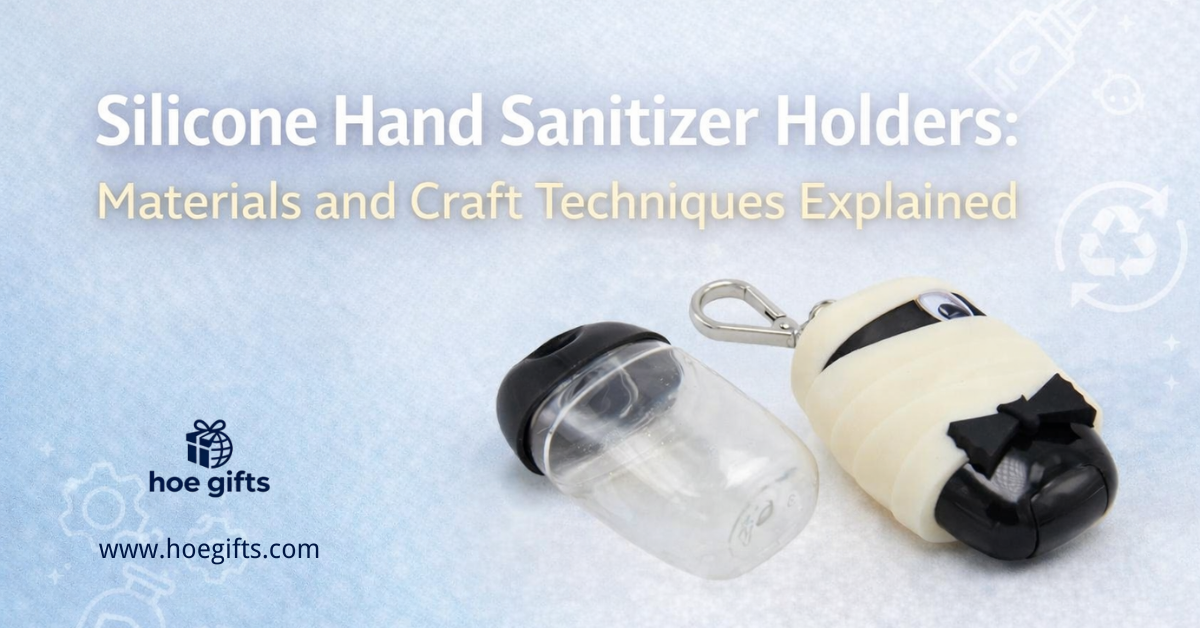

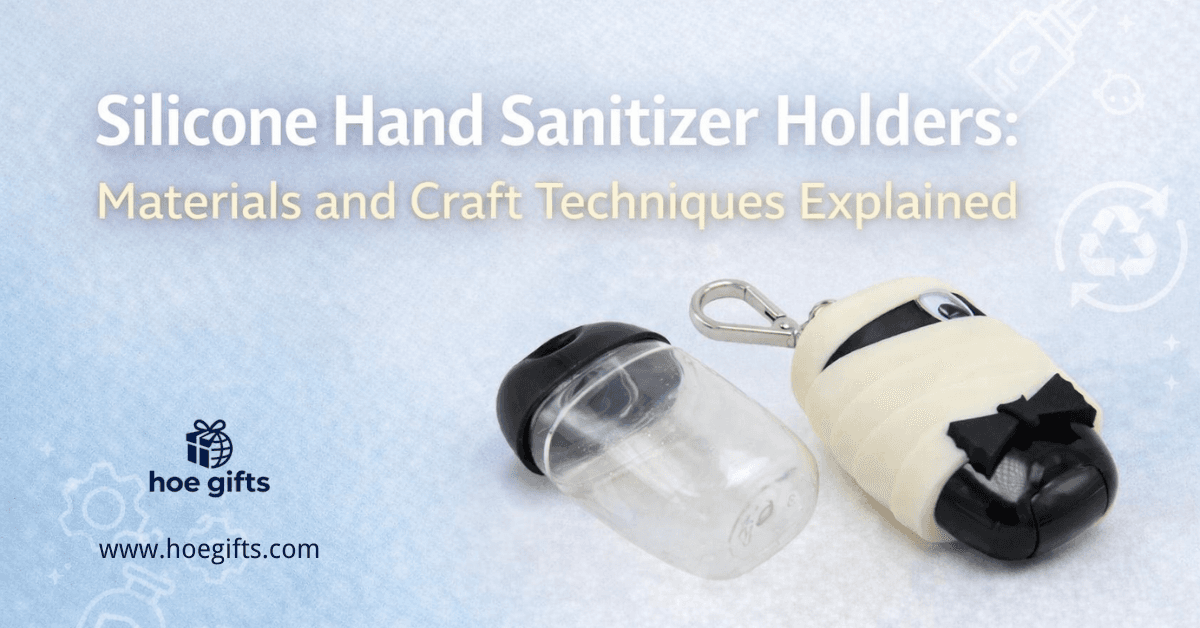
A silicone hand sanitizer holder looks like a simple accessory. In reality, a reliable holder depends on a series of small manufacturing decisions: the silicone grade, hardness, wall thickness, bottle fit, hanging structure, molding process, pigment ratio, logo method, and final curing conditions.
These details matter even more in wholesale and OEM projects. A sample may look attractive in a photograph but still fail after several days of use. The bottle may slide out, the strap may tear, the color may transfer, or the surface may attract excessive dust. When thousands of pieces have already been produced, a small design error becomes an expensive problem.
This guide explains the main silicone hand sanitizer holder materials, how the products are manufactured, and which silicone molding techniques are suitable for different designs. It is written for importers, gift companies, promotional product distributors, retailers, licensed merchandise buyers, and private-label brands planning a custom order.
Silicone Hand Sanitizer Holder Overview & Manufacturing Guide
Silicone hand sanitizer holders are usually made from solid silicone rubber through compression molding or from liquid silicone rubber through injection molding. Compression molding is common for colorful, shaped promotional holders because it offers stable quality and reasonable tooling costs. LSR injection molding is better suited to highly precise, soft, or technically demanding designs, although setup costs are usually higher.
For a successful bulk order, buyers should confirm the bottle dimensions, silicone hardness, wall thickness, pull strength, attachment type, logo method, color standard, compliance requirements, packaging, and an approved physical sample before production begins.
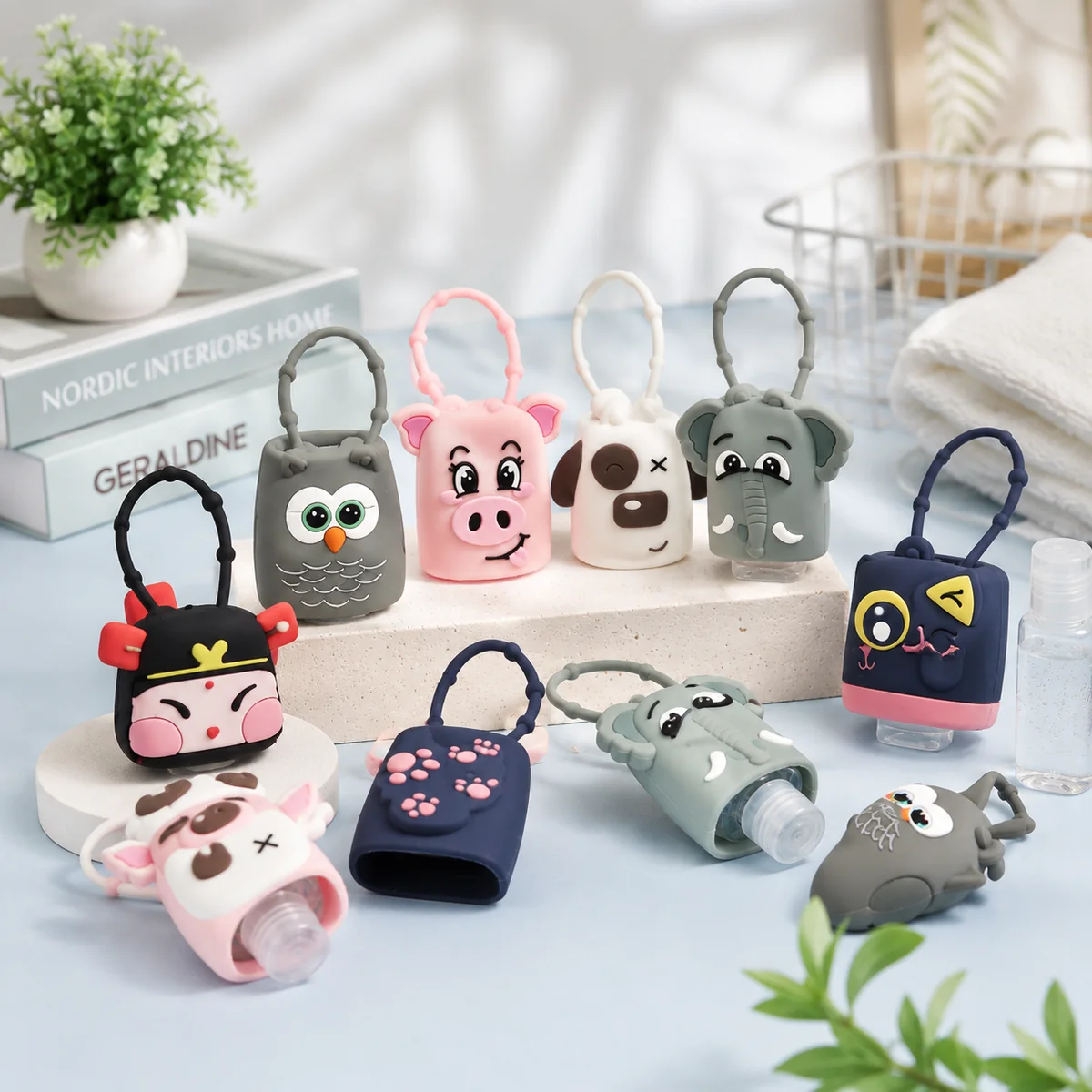
Key Buying Considerations for Silicone Hand Sanitizer Holders
- The right silicone formulation is more important than a vague “premium silicone” claim.
- Bottle fit should be tested with the actual sanitizer container, not only a drawing.
- Compression molding suits many decorative and promotional holders.
- LSR injection provides excellent repeatability but is not necessary for every design.
- Softness alone does not indicate quality; tear strength and recovery matter more.
- Added straps, clips, rings, and printed graphics require separate inspection.
- “Eco-friendly” and “food-grade” claims should be supported by relevant documentation.
- A golden sample should remain the reference for color, fit, finish, and assembly during mass production.
What Is a Silicone Hand Sanitizer Holder?
A silicone hand sanitizer holder is a flexible sleeve or case designed to carry a small bottle of hand sanitizer. Most designs include an opening for inserting the bottle and an integrated loop, strap, clip, or key ring for attaching the holder to a bag, backpack, belt loop, stroller, or travel case.
The product is widely used in:
- Promotional giveaways
- School and travel accessories
- Healthcare-related gift programs
- Retail hygiene collections
- Licensed character merchandise
- Corporate gifts
- Seasonal and event campaigns
The holder does not normally contact the sanitizer liquid directly. Its job is to grip the container, protect it from slipping out, and make the bottle easy to carry.
That distinction affects material selection. A supplier does not automatically need to use a food-contact formulation simply because the product is called a sanitizer holder. The correct material specification depends on the target market, user group, retailer requirements, skin-contact expectations, and any claims printed on the packaging.
Core Silicone Hand Sanitizer Holder Materials
“Silicone” is not one single material. Manufacturers adjust the base polymer, fillers, curing system, pigments, and additives to achieve different levels of softness, strength, color, and processing performance.
Solid Silicone Rubber
Solid silicone rubber, sometimes described as high-consistency rubber, is widely used for compression-molded accessories. Before curing, it has a dense, gum-like consistency.
This material works well for holders with:
- Thick walls
- Raised cartoon details
- Recessed logos
- Multiple color sections
- Decorative shapes
- Integrated hanging loops
It is commonly selected for OEM promotional items because the process can balance appearance, durability, and production cost.
Liquid Silicone Rubber
Liquid silicone rubber, or LSR, consists of two liquid components that are mixed and injected into a closed mold. The material flows easily into narrow areas and fine details.
LSR may be appropriate when the product requires:
- Precise dimensions
- Thin or complex sections
- Consistent softness
- Clean surfaces
- High production repeatability
- Automated high-volume molding
However, LSR equipment and molds are more complex. It is not automatically the best choice for a basic promotional holder. Buyers should select it because the design benefits from the process, not simply because “liquid silicone” sounds more advanced.
Curing Systems
Silicone can be cured through different chemical systems. Peroxide-cured silicone is common in many industrial and promotional applications. Platinum-cured silicone may provide cleaner processing characteristics and is often selected when stricter purity, odor, or regulatory requirements apply.
The curing method should be discussed early because it affects cost, production settings, post-curing requirements, odor, and compliance documentation.
Pigments and Additives
Color is created by mixing pigments into the silicone before molding. A bright cartoon holder may use several individually prepared colors, each placed into a different part of the mold.
Pigment selection affects more than appearance. Too much pigment, unsuitable color masterbatch, or inconsistent mixing may influence:
- Tear strength
- Surface texture
- Curing behavior
- Color migration
- Batch consistency
- Compliance results
For large orders, buyers should approve a physical color sample under normal lighting. Pantone references are useful, but silicone surfaces reflect light differently from coated paper or digital screens.
Choosing the Right Silicone Hardness
Silicone hardness is often measured on the Shore A scale. Many flexible portable accessories fall somewhere around the middle of the scale, but there is no universal number for every sanitizer holder.
A softer compound stretches easily around a bottle and feels pleasant in the hand. If it is too soft, though, the opening may loosen and the bottle may fall out.
A harder compound retains shape more effectively but can be difficult to install, especially when the holder has a narrow opening or deep molded details.
The right hardness depends on:
- Bottle dimensions
- Wall thickness
- Opening size
- Product shape
- Hanging weight
- Expected stretching
- User age
- Outdoor or indoor use
The most useful test is not squeezing a flat material swatch. It is repeatedly inserting and removing the intended bottle from a finished sample.
Material Comparison for OEM Projects
| Material option | Main characteristics | Typical use | Buyer considerations |
|---|---|---|---|
| Solid silicone rubber | Flexible, durable, suitable for thick decorative shapes | Promotional and cartoon holders | Cost-effective for many custom designs |
| Liquid silicone rubber | Precise, smooth, highly repeatable | Premium or technically complex holders | Higher mold and equipment requirements |
| Softer silicone compound | Easy stretching and comfortable handling | Small bottles and lightweight accessories | May loosen if walls are too thin |
| Higher-hardness compound | Better shape retention and support | Larger bottles or structured holders | Must remain easy to install |
| Platinum-cured formulation | Low odor and controlled curing | Projects with stricter material requirements | Higher cost may apply |
| Reprocessed or heavily filled material | Lower apparent cost | Low-end products | May reduce strength, color stability, and consistency |
A buyer should request a material specification instead of relying on terms such as “best silicone,” “100% eco silicone,” or “premium rubber.” Those phrases do not provide measurable acceptance criteria.
How Silicone Hand Sanitizer Holders Are Made
Understanding how silicone hand sanitizer holders are made helps buyers identify where quality problems begin. The process normally follows the stages below.
1. Product Brief and Bottle Measurement
The project starts with the actual sanitizer bottle or a complete dimensional drawing. Length, width, thickness, shoulder shape, cap position, and dispensing area must all be considered.
A two-millimeter difference can change the fit, particularly around the opening. For this reason, sending the physical bottle to the manufacturer is often safer than working only from photographs.
The design team also confirms:
- Overall appearance
- Character or graphic artwork
- Attachment position
- Strap length
- Logo placement
- Number of colors
- Packaging format
- Target quantity
2. 3D Design and Mold Engineering
The artwork is converted into a manufacturable 3D structure. At this stage, the engineer evaluates draft angles, undercuts, wall thickness, parting lines, venting, and the areas where flash may appear.
Decorative designs sometimes fail because the illustration was treated as a flat image rather than a molded object. Very thin ears, tails, limbs, or loops may tear during demolding or use.
A practical mold design may slightly thicken delicate areas or simplify deep recesses while preserving the overall visual identity.
3. Material Mixing and Color Preparation
The silicone compound is mixed with pigments and any approved additives. For compression molding, the material is usually prepared into measured pieces called preforms.
Accurate weighing helps control product weight and prevents incomplete filling or excessive flash. In multicolor designs, each color may need to be prepared and positioned separately.
Clean mixing and storage are important because dust, fibers, and foreign particles are easy to see on a smooth silicone surface.
4. Molding and Curing
The prepared silicone is placed or injected into a heated mold. Heat and pressure cause the material to flow and cure into the final shape.
Cycle time depends on:
- Silicone formulation
- Product thickness
- Mold temperature
- Number of cavities
- Color arrangement
- Curing system
- Product geometry
Removing the part too early can leave it under-cured or distorted. Excessive heat or time may affect color, surface finish, and productivity.
5. Demolding and Trimming
After curing, the holder is removed from the mold. Thin excess material around the mold separation area, known as flash, must be trimmed.
Trimming can be manual or supported by specialized equipment. Complex cartoon designs often require careful hand finishing near small details.
Poor trimming leaves rough edges. Over-trimming can damage the loop, opening, or decorative outline.
6. Post-Curing When Required
Some formulations or applications require post-curing in a controlled oven. This stage can help stabilize the material and reduce certain residual substances or odors.
Post-curing is not identical for every silicone product. The need, temperature, and duration should be based on the formulation and compliance requirements rather than applied as a generic marketing claim.
7. Logo and Decorative Finishing
Branding may be molded into the product or added after molding.
Common options include:
- Embossed logo
- Debossed logo
- Raised multicolor logo
- Screen printing
- Pad printing
- Laser marking
- Additional molded decoration
A molded logo is generally durable because it forms part of the product. Printing offers greater graphic flexibility but requires suitable ink, surface preparation, curing, and adhesion testing.
8. Attachment Assembly
Depending on the design, the factory may install:
- Silicone strap
- Plastic hook
- Metal split ring
- Lobster clasp
- Carabiner
- Fabric lanyard
- Beaded chain
The attachment is often the first component to fail in use. Its strength should therefore be tested separately from the silicone body.
9. Inspection and Packaging
Finished holders are inspected for fit, appearance, color, contamination, flash, damage, printing, and assembly.
They may be packed in individual polybags, paper sleeves, retail boxes, display cards, or bulk cartons. Packaging should prevent printed surfaces and metal parts from rubbing against one another.
Main Silicone Molding Techniques
Compression Molding
Compression molding is widely used for decorative sanitizer holders. Pre-measured silicone is placed into a heated mold, which closes under pressure.
Its advantages include:
- Reasonable mold cost
- Good suitability for solid silicone
- Reliable production for thick parts
- Easy integration of raised details
- Practical multicolor molding
- Strong fit for promotional orders
Its limitations include more manual material placement and trimming. Highly complex multicolor designs can also require additional labor.
LSR Injection Molding
In LSR injection molding, liquid components are metered, mixed, and injected into a closed heated mold.
Advantages include:
- High dimensional repeatability
- Efficient automated production
- Good flow into detailed cavities
- Smooth surface quality
- Reduced manual handling
The process usually requires more sophisticated molds and machinery. It is most economical when volume and design requirements justify the setup.
Transfer Molding
Transfer molding pushes silicone from a chamber into the mold cavities. It can support shapes that are difficult to fill through basic compression molding.
It is less commonly discussed in promotional product sourcing but may be useful for certain multi-cavity or technically structured parts.
Molding Method Comparison
| Method | Tooling level | Production efficiency | Detail capability | Best suited for |
| Compression molding | Medium | Medium | Good | Decorative and multicolor OEM holders |
| LSR injection molding | High | High | Excellent | Precision parts and large-volume programs |
| Transfer molding | Medium to high | Medium | Good | Selected complex or multi-cavity designs |
| Simple cut-and-assembled silicone | Low | Low | Limited | Basic prototypes or flat promotional items |
The cheapest tool is not always the lowest-cost solution. A mold with too few cavities may produce an attractive quotation for tooling but create a longer lead time and higher unit cost during bulk production.
Functional Details Buyers Should Test
Bottle Retention
The holder should grip the bottle during normal movement without making refilling difficult. Test the product while hanging from a bag and after repeated insertion cycles.
Tear Resistance
The narrowest point near the loop, opening, or decorative extension deserves close attention. A thick body does not compensate for a weak connection point.
Shape Recovery
Stretch the holder and allow it to rest. It should return close to its original form instead of remaining loose or distorted.
Surface Condition
Check for stickiness, powder, excessive dust attraction, oil marks, uneven gloss, and visible particles.
Strap and Clip Strength
A strong silicone sleeve is of little value if the metal ring opens or the plastic clip breaks. Test the complete assembly.
Printing Adhesion
Printed details should be tested through rubbing, bending, and normal cleaning. Approval based only on a fresh sample may miss later adhesion problems.
Practical Quality-Control Checklist
| Inspection point | What the buyer should confirm |
| Material | Approved formulation, hardness, color, and required documentation |
| Dimensions | Holder size and bottle-opening tolerance |
| Fit | Actual bottle remains secure during movement |
| Appearance | No dirt, bubbles, major flash, stains, or distortion |
| Color | Matches the approved master sample within agreed tolerance |
| Strength | Loop, strap, clip, and opening withstand expected use |
| Printing | Correct position, clear edges, acceptable adhesion |
| Odor | Within the agreed acceptance level |
| Assembly | Metal and plastic accessories installed securely |
| Packaging | Correct quantity, labeling, barcode, and surface protection |
For larger programs, inspection criteria should be written into the purchase specification. “Same as sample” helps, but it is stronger when supported by measurable dimensions, approved colors, test methods, and defect limits.
Compliance: What Buyers Should Confirm
Material compliance depends on the destination and the way the product is marketed.
REACH-related chemical requirements may be relevant for products sold in the European Union. Retailers may also maintain their own restricted-substance lists.
RoHS is primarily associated with electrical and electronic equipment. It should not automatically be presented as the main certification for a standalone silicone holder unless the buyer, retailer, or product configuration specifically requires it.
For products marketed to children, additional rules may apply to chemical content, small parts, labeling, and mechanical safety. Metal clips, paints, prints, and packaging must also be considered—not only the silicone body.
Buyers should ask for documentation that matches:
- The actual production material
- The finished product configuration
- The destination market
- The intended age group
- The claims printed on the product or packaging
A generic report for unrelated silicone does not prove that the final custom product meets the required standard.
OEM and ODM Customization Options
Silicone holders offer strong customization potential. Buyers can adjust:
- Bottle size and opening
- Overall shape
- Cartoon or mascot design
- Silicone hardness
- Color combination
- Surface texture
- Logo style
- Strap or clip
- Individual packaging
- Display cards and gift boxes
OEM usually starts from the buyer’s existing artwork or product specifications. ODM may involve concept development, character design, structural improvement, and packaging proposals from the supplier.
For licensed characters, the buyer and manufacturer should confirm authorization before tooling begins. A factory’s ability to mold a character does not grant the legal right to produce it.
MOQ, Tooling, and Lead-Time Factors
The MOQ for a silicone hand sanitizer holder depends on more than factory policy. It is influenced by the number of colors, custom mold, silicone formulation, printing, accessories, packaging, and production efficiency.
A simple one-color design made with an existing mold may support a lower order quantity. A new five-color cartoon design with custom packaging needs more setup work and may require a higher MOQ.
Project time usually includes:
- Artwork confirmation
- 3D drawing
- Mold production
- Mold testing
- Sample revision
- Color approval
- Packaging proofing
- Bulk molding
- Printing and assembly
- Inspection and shipping
Buyers should request a complete schedule rather than asking only for “production lead time.” Mold revision and sample approval often take longer than expected.
What Affects the Unit Price?
The main cost factors include:
- Product weight
- Silicone grade
- Number of colors
- Mold size and cavity count
- Molding cycle
- Manual color placement
- Trimming difficulty
- Printing method
- Strap and hardware
- Individual packaging
- Order volume
- Testing and inspection
A visually small holder is not always inexpensive. A lightweight design with six individually placed colors and delicate trimming may cost more to produce than a larger one-color sleeve.
Sustainability Without Exaggerated Claims
Silicone holders are reusable and can protect a refillable bottle over an extended period. That durability may reduce the need for repeatedly replacing cheap carrying accessories.
Still, silicone should not be described as biodegradable. It is also not commonly accepted in household curbside recycling systems.
More credible sustainability improvements include:
- Designing the holder for longer service life
- Reducing avoidable material thickness
- Using replaceable or durable attachments
- Minimizing production rejects
- Choosing recyclable paper packaging
- Reducing oversized cartons
- Avoiding unsupported environmental claims
For B2B buyers, honest wording is safer than broad terms such as “100% green” or “fully recyclable.”
How to Evaluate a Silicone Holder Manufacturer
Before selecting a supplier, ask practical questions:
- Does the factory mold silicone in-house?
- Which molding processes are available?
- Can it explain the recommended hardness?
- Will it test the holder with the real bottle?
- How are multicolor parts positioned?
- What is the weakest point in the design?
- Can it provide material and test documentation?
- How is print adhesion checked?
- Is a golden sample retained?
- How are repeat-order colors controlled?
- Can the factory develop export and retail packaging?
- How are defective goods handled?
A reliable manufacturer may suggest changing a thin loop, enlarging an opening, or simplifying a deep detail. That is usually a positive sign. Good engineering sometimes means challenging the original artwork before it reaches production.
Frequently Asked Questions
1. What material is used for silicone hand sanitizer holders?
Most are made from solid silicone rubber or liquid silicone rubber. The formulation and hardness depend on the design, bottle weight, compliance requirements, and molding process.
2. Is food-grade silicone necessary?
Not always. The holder normally carries the bottle rather than contacting its contents. The required material standard depends on the market, user group, retailer specification, and product claims.
3. Which molding process is most common?
Compression molding is common for decorative and promotional holders, especially products with thick walls, raised details, and several colors.
4. Is LSR injection molding better than compression molding?
It offers excellent precision and automation, but it has higher setup requirements. Compression molding may be more economical for many standard custom designs.
5. How do I choose silicone hardness?
Base the decision on the actual bottle, wall thickness, opening, hanging weight, and desired flexibility. Always test a finished sample rather than relying only on a Shore A number.
6. Can a silicone holder have several colors?
Yes. Multicolor silicone can be created through manual color placement, multiple molding stages, printing, or a combination of processes.
7. Can I add a custom logo?
Yes. Logos can be embossed, debossed, molded in color, screen printed, pad printed, or laser marked, depending on the design and durability requirement.
8. Why does a bottle fall out of a silicone holder?
Common causes include an oversized opening, material that is too soft, insufficient grip area, incorrect bottle dimensions, or permanent stretching after use.
9. What should be checked before mass production?
Confirm the physical sample, dimensions, bottle fit, hardness, colors, logo, attachment strength, packaging, documentation, and inspection standard.
10. What determines the MOQ?
MOQ depends on tooling, number of colors, material, printing, packaging, accessories, and the efficiency of the planned production run.
11. How long does custom development take?
The schedule includes design, mold making, testing, sample revisions, approvals, production, and inspection. A supplier should provide separate timings for each stage.
12. Are silicone sanitizer holders recyclable?
Silicone can be processed through specialized recycling routes, but it is not commonly accepted in household recycling. Reusability and long product life are more defensible sustainability benefits.
Conclusion
A good silicone sanitizer holder is not defined by softness or bright color alone. Its performance comes from the relationship between material formulation, wall thickness, bottle fit, molded structure, curing, attachments, finishing, and quality control.
For most decorative OEM projects, compression-molded solid silicone provides a practical balance of customization and cost. LSR injection molding becomes valuable when precision, thin features, automation, or very high repeatability are central to the project.
Before requesting a quotation, prepare the actual sanitizer bottle, target dimensions, artwork, estimated quantity, market, attachment style, packaging requirement, and required compliance documents. Ask the supplier to identify weak points before opening the mold.
A physical sample should then be tested as a complete product—not simply displayed on a desk. Insert and remove the bottle repeatedly. Hang it from a moving bag. Pull the strap. Rub the printing. Inspect the opening after stretching.
These ordinary tests reveal far more about product quality than a polished catalog photograph.
For a custom silicone hand sanitizer holder project, request a material recommendation, manufacturing review, prototype, and detailed quotation before confirming mass production. A careful development process protects the launch schedule, reduces quality disputes, and creates a product that customers can actually use.